Vaccination Updates
On Monday, January 5, Secretary Robert F. Kennedy, Jr. announced unprecedented changes to the childhood vaccination schedule. The Centers for Disease Control and Prevention (CDC) decreased the number of diseases for which they recommend routine vaccination. Previously, the CDC recommended vaccines to protect against 17 diseases and now they recommend vaccines against only 11 diseases. Although Hepatitis A and B, RSV, rotavirus, HPV, and meningococcal disease are no longer federally recommended for all children, many state and local public health departments continue to routinely recommend them for all children. The CDC’s update also rescinded the recommendation that everyone over 6 months receive flu and COVID-19 vaccinations, amidst one of the worst flu seasons in years.
To be clear, none of these changes were driven by new data. They said that the recommendations align our recommendations with those of other countries, like Denmark. The reality is that the former US recommendations were designed in a US-based context and have prevented more than 508 million illnesses and 1.1 million deaths.
Though this nonsense causes confusion and contributes to overall vaccine hesitancy, ultimately states with more protective policies overrule and determine school-based vaccine recommendations. We will be watching what states do in the face of these new recommendations and encourage advocacy at the state level to pressure states to continue recommending the original vaccination schedule.
The Weather
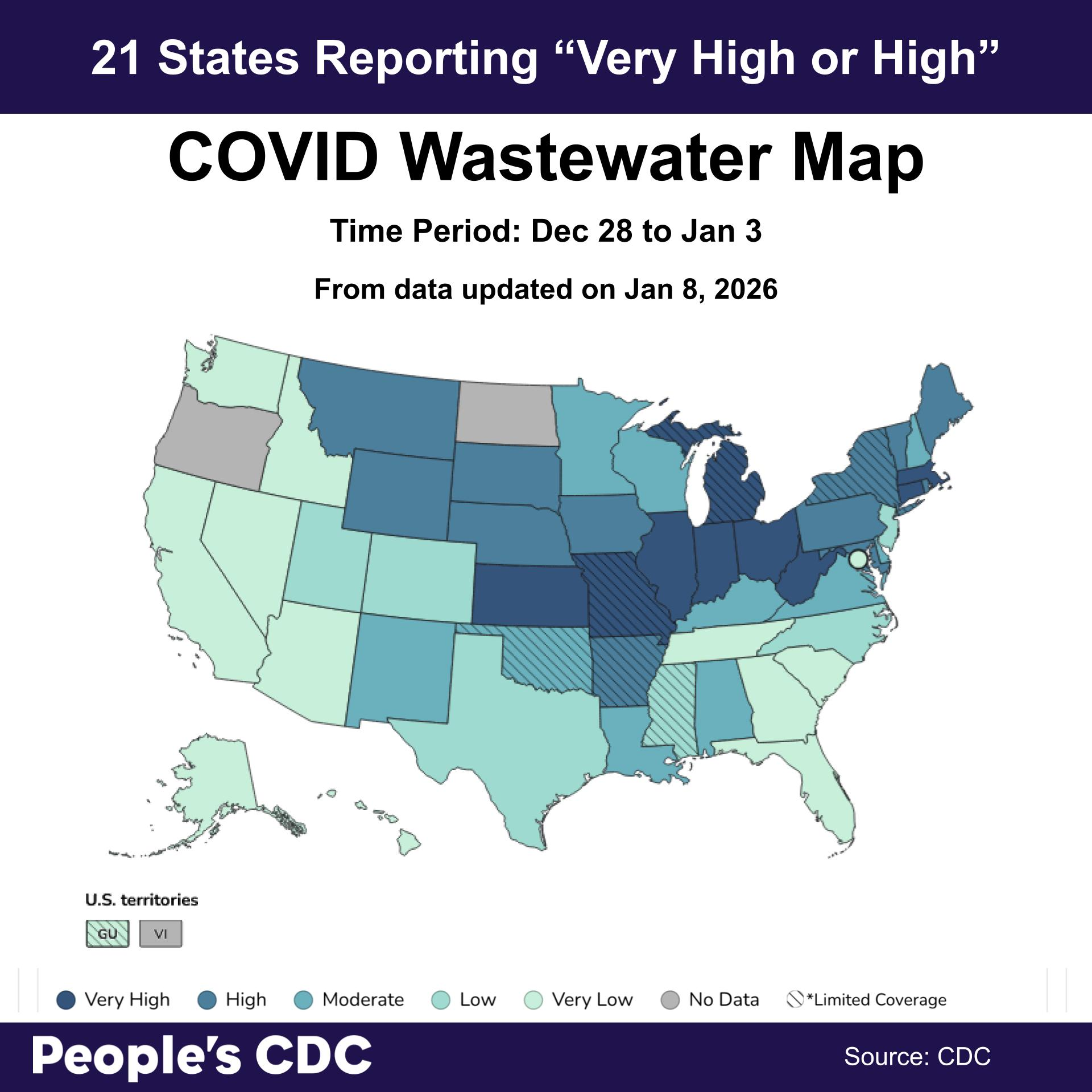
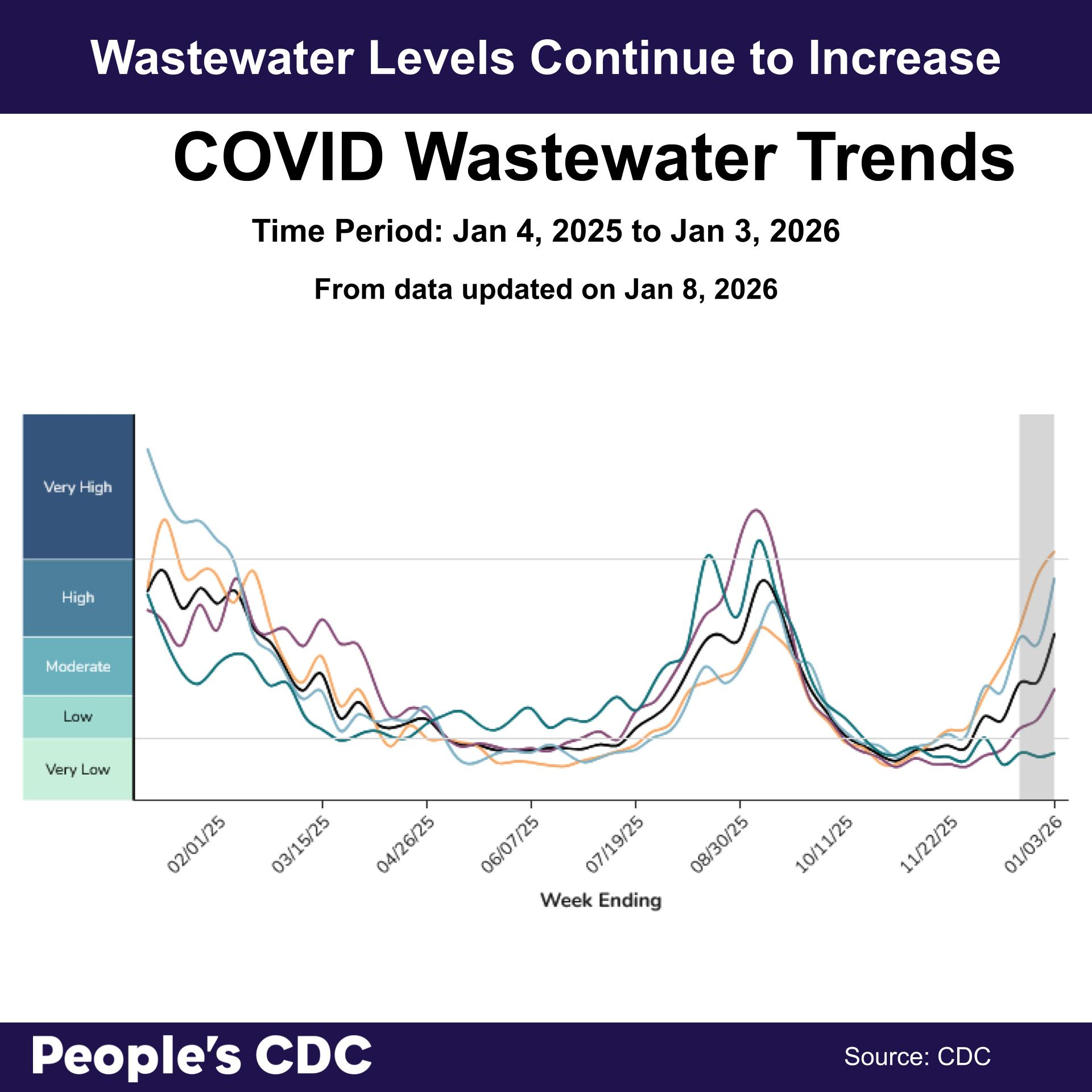
Wastewater levels for COVID have reached “high” for parts of the US. The CDC-based wastewater map was updated on January 8, and it shows “very high” levels in 9 states, “high” levels in 12 states, “moderate” levels in 10 states, “low” levels in 6 states, and “very low” levels in 13 states and territories. Seven states report limited coverage: only some of the state’s wastewater centers are reporting, so the data are based on less than 5% of the population, and they may not be accurate for the entire state. North Dakota and the Virgin Islands continue to not have any data with the addition of Oregon this week. Regional data indicate that all regions are seeing SARS-CoV-2 detection in wastewater increasing, the regions of Midwest and Northeast have both risen substantially reaching very high or high levels while the South is at moderate and West is at very low levels.
Note: Our warm-tones wastewater map is currently under construction, but look for its return in this year.
As Flu, COVID, and RSV surge around the US, remember, using multiple layers of protection is the most effective way to avoid an infection. For example, at your gatherings this winter, you could combine ventilation, vaccination requirements, and the required use of N95/KN95/KF94 masks. Vaccination with the most updated booster is essential because it helps reduce the chances of death and hospitalization. However, vaccination alone will not help avoid infection altogether. COVID can damage the entire body, and even non-severe and asymptomatic cases increase the risk for complications such as Long COVID down the line. Layers of protection are essential to protect you and the ones you love from developing chronic illness and disability.
As people have completed their holiday gatherings, our Safer Holiday Gatherings remain useful during this time of high levels of COVID. Share with your family, friends, colleagues, or neighbors. You may find them on our Safer Gatherings Guide page and videos on our instagram. You will also find a complete list of the layers of protection available to us, along with more information on creating an accessibility policy for your next gathering.
Emergency Room Use
Another sign of the profound impact of COVID is the percentage of emergency room visits involving a new COVID diagnosis. According to the CDC, the proportion of Emergency Room visits involving a COVID diagnosis has increased to 0.9% on January 3rd from 0.4% on December 6th, an increase indicating the severity of COVID among the general population.
Vaccination with the most updated boosters of COVID, flu, and RSV remains safe and effective at decreasing one’s risk for death and hospitalization from these diseases. It is essential that we all stay up to date with the latest available vaccination. The CDC’s free vaccine finder tool, vaccines.gov, remains broken, but many pharmacies and local health departments offer these vaccines. When you arrive at your appointment, ask the pharmacist to confirm whether your insurance will cover the full cost. If you don’t have insurance, or your insurance doesn’t cover the full cost of the updated COVID, flu, and RSV vaccinations, contact your local health department or a federally qualified health center.
Paxlovid, antiviral treatment for COVID, remains available to the public. The US Government Patient Assistance Program (USG PAP), an invaluable program to those with Medicare, Medicaid, or no insurance, offering no cost access to Paxlovid, was renewed through the end of calendar year 2026. You may learn more on how to obtain access through the USG PAP program.
Nearly 15,000 nurses walked off the job this week in New York City in the largest nursing strike in NYC history. The striking nurses, organized by the New York State Nurses Association, are demanding pay increases, staffing guarantees, and protections against workplace violence.
An additional 750 nurses in Flint, Michigan, organized by Teamsters Local 332, have been on strike for over 130 days. These nurses work at the Henry Ford Genesys hospital and are rightfully demanding safer nurse-to-patient staffing ratios that will benefit both nurses and patients. We look forward to the nurses winning the contracts they and their patients deserve.
Actions
Remove RFK Jr. petition: We continue to call for the removal of RFK Jr. Stand Up For Science has created its own petition calling for the removal of RFK Jr. as Secretary of Health and Human Services. We encourage you to read it and sign on.
With the major increase in spread of COVID, flu, RSV, and measles in the US, we need to keep ourselves and our communities safe using KF94/KN95/N95 masking and as many layers of protection as possible. Our Safer Gathering Guide provides recommendations for safer meetings and gatherings. Please continue to share it!
Notes: 1) The numbers in this report were current as of 1/14/2026. 2) Check out the links throughout & see our website for more at https://peoplescdc.org. 3) Subscribe to our newsletter: People’s CDC | Substack.
If you’re donating to us through Substack, consider getting the Substack for free (it’s not paywalled!) and donating to us directly. That way, there are fewer fees for everyone.