The People’s CDC talked with ACT UP New York about the NYC free condom program, the New York Health Act, and their advocacy for the NYC Department of Health and Mental Hygiene (DOHMH) to strengthen their existing free clinic system with longer hours, more locations, free COVID/Flu/RSV PCR testing and city-run services for Gender Affirming Care, and to provide free access to KN95 masks in libraries, health centers, subways, and bus stations.
The People’s CDC is starting a series of interviews with organizers doing public health advocacy on a local level in different regions across the United States. The point of these interviews is to inspire listeners and readers to take up similar work in their local areas. The first interview of this type is with ACT UP NY and will be released in June of 2026 in honor of New York and National Pride Month.
Q: What is your free clinics advocacy campaign? And how long has it been going on?
The free clinics campaign seeks to update and rethink how the city’s sexual health clinics operate in our new reality of increasing and ongoing deadly pandemics (HIV, COVID, MPOX, etc).
We began the free clinics campaign in 2024 after realizing that the city’s Department of Health and Mental Hygiene (DOHMH) was slowly winding down COVID testing and services in each borough of NYC and that operating hours at their existing sexual health clinics were not returning to pre-COVID schedules. For decades, the city has operated free sexual health clinics across the city, and they currently operate 2 clinics in Manhattan, 2 in Queens, 1 in Brooklyn, and 1 in the Bronx. (Staten Island does not currently have a clinic.)
As can be imagined, 1 or 2 clinics operating, under the best of circumstances, Monday thru Friday 9am-5pm in a borough of 1-3 million people cannot begin to scratch the surface of the needs of those without access to regular healthcare or who are in a health emergency and in need of PEP, HIV testing, abortion services, etc. Add to that fact that during early COVID, clinics reduced hours to close at 3:30pm every day and prioritized patients with appointments while walk-in patients were turned away or made to wait for hours. The clinics have maintained their early COVID operations now including closing at 3:30pm every day.
The problem of clinic overcrowding is so bad that clinics can start turning walk-ins away earlier than 3:30pm because the line is too long and they would never be seen by close. Perhaps the most diabolical aspect of the 3:30pm closing time is that clinics close right as high schools are ending their day, so students have little chance of walking in at a clinic outside of their school hours. Under 18 young people are a sexually active, high risk population that we want to reach with counseling and treatment, and DOHMH has essentially forgotten them!
Also, invariably, one of the sexual clinics is almost always closed by DOHMH for months for renovation, updates, painting, etc. This usually happens without much or any warning, and usually lasts at least 6 months. But most people would never know their clinic is closed until they need services and check online or visit the building, where they would be directed to visit another borough that could be 1-2 hours away by public transportation. In that situation, that one clinic in the other borough is way overcrowded trying to fill the needs of 2 boroughs! (We have learned the solution to this is to set up a mobile unit outside the temporarily closed clinic, but we have to fight DOHMH and advocate for that mobile unit EVERY TIME a clinic closes.) — Brandon
Q: What goals is this campaign trying to accomplish?
We are tired of the reduced hours, early closures and reduced geographic coverage at the Sexual Health Clinics. Eight million people cannot share 6 clinics. We are tired of the wind down of free COVID/Flu/RSV PCR testing and treatment services while the Flu and RSV still spread seasonally and while COVID still spreads year-round. And we are tired of DOHMH pitting one type of care against another and asking its constituents to choose who is able to receive care and for what ailment. Our free clinics should be the first line in testing and treatment for any virus that New Yorkers face. Revoking any service that once existed while that virus is still spreading is segregating the option to be treated away from those who have less money, and in this economy none of us know at what point we will fall into that category. At what point we will either need free care or seek it out only to realize that our access to treatment has been taken away.
Our campaign seeks to:
Reopen the “temporarily closed” sexual health clinics in Crown Heights, Riverside, and Staten Island to restore the NYC free sexual health clinic system to 9 total locations;
Extend the hours at all DOHMH sexual health clinics from 8:30am – 3:30pm, Monday – Friday to 8am – 8pm, Monday – Saturday to accommodate daytime workers and school-aged teens;
Resume COVID/Flu/RSV PCR testing and add it to the menu of the sexual health clinics instead of creating false binaries that pit the availability of these services against one another;
Introduce gender affirming care services at each clinic to become the first city-run and city-funded option for gender affirming care, combating gaps in services due to cuts at a federal level;
Provide van services to immigrant neighborhoods who are avoiding health services due to targeting by ICE;
Make the existing abortion hotline into a transgender health navigation + abortion navigation hotline;
Provide proper staffing at all clinic locations, at the moment some clinics especially in Harlem and the Bronx, are short staffed and forced to close early;
Purchase the Manhattan Planned Parenthood location that closed last year before it is sold to luxury developers and institute city-run abortion services to combat the loss in services from what was once a DOHMH service-provider;
Make PrEP Continuity of Care — a program that pays patients for keeping up with their PrEP regiment — available at all clinic locations;
Make The Undetectables Program – a program that pays HIV+ patients for keeping up with their ART treatment regimen subsequently maintaining an undetectable viral load – available at all clinic locations;
Make medication abortion available at all clinic locations;
Roll out a city-wide KN95 mask distribution program with distribution at sexual health clinics, hospitals, libraries, churches, non-profits and subway stations. — Exx
Q: What is the NYC free condom program?
The NYC free condom program gives away millions of free safer sex products like condoms and lubricant at 1,000 locations throughout the 5 boroughs of New York City. The program is managed by the city’s Department of Health and Mental Hygiene (DOHMH). It has been paid for through various funding streams with an operating budget of around $300,000 in 2019. The program ships safer sex products to bars, shops, community centers, health centers, and churches which enroll for the program through a web portal. The web portal allows everyday NY-ers to search for condoms, lubricant, etc by zip code and locate distribution sites near them. — Brandon
Q: What advocacy contributed to this program being founded?
New York City’s free condom program started in 1971, with free condoms distributed through the city’s clinics for sexually transmitted infections. In 2005, the program expanded to the internet to provide community and social service organizations with condoms. In 2007, the Health Department launched the NYC Condom as a way of marketing the program and use of condoms. — Brandon
Q: Since its founding have you had to do any maintenance advocacy work to keep it alive?
Despite being over 50 years old and the largest and most successful condom program in the US, NYC’s free condom program faced its biggest threat during early COVID when service was interrupted for years.
During the early stages of COVID, the program virtually shut down when businesses weren’t open. In 2023, after businesses had reopened and were seeing more patrons, we started hearing from bar staff that the condom program had not resumed and that the web portal used to order more safer sex products was broken. Until 2023, many businesses assumed that their situation was an anomaly and that it was their own user error or a tech glitch that was preventing them from ordering supplies. The Dept. of Health and Mental Hygiene (DOHMH) had not sent out any communication about the status of the condom program and the fact that it was halted indefinitely.
One ACT UP member who works in bars visited and contacted a number of businesses to put the pieces together that no venue had received condoms since 2020 and that the program had been quietly halted by DOHMH.
In early 2024, we reached out to DOHMH and learned that they have staff paid to administer the free condom program through an outside vendor contracted to run the web portal and deliver the condoms. We met virtually with DOHMH and learned that the program had been defunded months before after changes to the way federal funding for the program was awarded. At that time, there seemed to be no plans in the works or desire to find new funding. We essentially pleaded with them how important condoms are to the LGBTQ+ community that is most at-risk for HIV, MPOX and other STDs, especially low-income people without regular access to healthcare. It was a bizarre dynamic for us as community members to have to explain to DOHMH staff how much the free condom program means to the community and HIV prevention.
With June Pride month only a couple months away, we offered many stopgap solutions to resume the program (soliciting donations, enlisting activists to do the legwork, finding a sponsor), but ultimately, DOHMH was not interested in any of them. We had just begun a social media campaign about the defunded free condom program when, at the next meeting with DOHMH (we had arranged follow-up meetings with them until the problem was resolved), they announced that they had found a new source of funding for the condom program and it would resume over the summer. DOHMH followed through and hired a vendor to fix the web portal and resumed delivery of safer sex products to local businesses, health centers, etc. (We never learned what the DOHMH condom program staff were doing while the program was not in operation from 2020-2024.)
That experience was a brutal lesson in how quickly the onset of a newer and concurrent crisis like COVID can be used as an excuse for bureaucratic negligence and indifference that is powerful enough to undermine one of an organization’s core missions, in this case, STD prevention through condom distribution. — Brandon
Q: How are HIV and COVID connected?
HIV and COVID have caused the deaths of millions of people. The Trump administration has defunded HIV/AIDS prevention and treatment services, and it has defunded COVID and Long COVID research too. HIV and COVID have both disproportionately impacted minority communities, and misinformation and bigotry has led to these communities being violently targeted and discriminated against, in and outside of healthcare settings.
Without ACT UP and other AIDS activist groups, we would not have PrEP and PEP, we would not have medication that makes HIV undetectable, and these services would not be available worldwide. Much of the early response to COVID was informed by AIDS activists and experts who understood the nature of infectious diseases better than anybody. Sooner than most, they grasped the enormity of COVID, and many of them expanded their attention from HIV/AIDS prevention to also include COVID prevention. In 2020, AIDS organizations had no funding or grants for COVID, and yet many of them paused what they were doing, covertly redirected existing grants toward this new disease, and worked longer than normal hours to prioritize COVID.
Our history has taught us that the government is not going to protect us; we protect us. While ACT UP continues our fight to end AIDS, we also continue to fight for COVID prevention and treatment services, like free PCR tests, KN95+ masks, vaccines, and antivirals. HIV/AIDS is not over, and neither is COVID. — Mo & Brandon
Q: How do HIV and COVID or Long COVID affect the transgender community?
HIV-positive and transgender people are at higher risk for COVID-19 and Long COVID than the general population. Both populations face healthcare access barriers such as provider discrimination, loss of insurance, and rising costs, as well as racial, ethnic and socioeconomic disparities that impact their ability to get high-quality, affordable and timely health services.
HIV, Long COVID, and the Transgender Community:
A 2024 report by the NYC Department of Health and Mental Hygiene found that transgender people represented 4% of new HIV infections, with Black and Latinx trans people representing 88% of new infections among trans people in NYC.
Compared to the general population, trans and nonbinary people are more likely to report Long COVID, according to a study by Johns Hopkins.
A study from the University of South Carolina found that HIV-positive people had higher rates of Long COVID This may be attributed to chronic immune activation and inflammation, even among those receiving antiretroviral therapy.
Long COVID disproportionately impacts people experiencing unfavorable social determinants of health, like HIV-positive and transgender people.
This is why ACT UP NY is fighting to expand services, locations and working hours at NYC’s free clinics. We need to expand COVID testing, provide free masks, and push our elected officials to enact the New York Health Act. Our current system is not working, and it’s up to us to change it. — Mo
Q: In what ways do you anticipate the healthcare cuts in the Big Beautiful Bill or Trump policies in general will affect the HIV+, HIV-at-risk and LGBTQ citizens in NYC? And nationally?
Eight percent of New Yorkers identify as LGBTQ+; more than 100,000 New Yorkers are living with HIV, with thousands of positive diagnoses per year, according to New York State data. Any Trump Healthcare cuts proposed or enacted will indubitably affect HIV+, at-risk, and LGBTQ+ New Yorkers disproportionately to their counterparts.
They already have. Here’s how.
About a year ago the House passed The One Big Beautiful (ugly) Bill (OBBB) in a vote of 215-214 May 22, 2025. The bill prioritizes high income earners in addition to corporations and families, but absolutely disparages working people with lower incomes. The bill’s changes to Medicaid alone could result in as many as 7.6 million Americans losing health insurance (of which 1.8 million are LGBTQ+) over the next 10 years, according to initial estimates by the CBO. Instead, funding increases in other departments like the Department of Homeland Security (DHS) (total: $190.6 billion through to 2029), the Pentagon ($1.5 trillion, or a 42% increase) , and Immigration & Customs Enforcement (more than $70 billion under the DHS total budget).
These federal cuts hit New Yorkers particularly hard.
Thirty-five percent of New Yorkers across the state get healthcare through Medicaid, one of the highest shares of any state in the country, according to an analysis by New York Comptroller Brad Lander. Additionally, proposed federal cuts would impact over 4 million New Yorkers on Medicaid, nearly 3 million New Yorkers on SNAP.
As we see the effects of Trump’s cuts to LGBTQ+ and HIV-positive or at-risk New Yorkers, Health and Human Service (HHS) Secretary RFK, Jr. testified on April 21, 2026 before Congress to explain a projected 12.5% ($15.8 billion) budget cut request to the HHS. With rising costs, flat funding to the HHS in addition to 1.5 billion in proposed cuts to HIV prevention and related public health services, the Administration’s priorities couldn’t be clearer.
Due to continued flat funding of integral public health programs like the Health Resources and Services Administration (HRSA), the Ryan White Program Part B, the AIDS Drug Assistance Program, is drying up in states like Florida, Iowa, Illinois, Missouri and 19 other states leaving people without medication they cannot risk missing a single dose of or find the HIV virus mutating, immunizing itself from life-saving medication, while wasting money from global health initiatives like Ending the HIV Epidemic. (Lana)
All this, and transgender, nonbinary, and gender nonconforming people, disproportionately affected by HIV, cannot access healthcare as they could prior to Trump’s Presidency. Since returning to office, Trump has had an all out war on trans New Yorkers, issuing executive orders that threaten weaponization of federal funds for an end to gender affirming care for minors and adults 19 years of age. This has led to refusals in care at major hospital systems like Mt. Sinai, New York Presbyterian, or NYU Langone, which was, this month, issued a grand jury subpoena from the U.S. Attorney’s Office in the Northern District of Texas.
People laud New York for its healthcare system, but today it faces unprecedented threats from an Administration who clearly doesn’t see HIV-positive, at-risk communities, and LGBTQ+ people as human enough to keep healthy. That is why we need the extra $30.5 million added to the Department of Health and Mental Hygiene (DOHMH) budget this year; that is why we need the New York Health Act; that is why we need to tax the rich. We need free NYC clinics to serve those in NY and throughout the country who cannot rely on the federal government nor insurance companies to provide the necessary healthcare they need and deserve. — Lana
Q: In what ways does your advocacy work to future-proof against the harms that these cuts will cause, i.e. people losing healthcare coverage, transgender youth losing access to gender affirming care and immigrant populations losing access to health services due to ICE intimidation?
When people’s rights and access to healthcare are protected at the city and state level, it becomes harder to take away access at the federal level. We have been advocating for the New York Health Act because not only would it provide healthcare coverage for everyone, but everything would be included. Not only that, the NYHA is popular! Democratic support is at 79%, Union support is 72%, and total overall support is at 68%, according to Physicians for a National Health Program – New York Metro Chapter (PNHP) Sienna polling data.
The NYHA will help all New Yorkers regardless of employment status.
Trans people, especially youth, would be able to access gender affirming care. Immigrant populations wouldn’t have to worry about ICE intimidation. People wouldn’t have to worry about losing their healthcare coverage or whether a doctor was “in network.” No matter what the federal government did, all of these people would be covered. This also relates directly to our work with the Sexual Health Clinics in NYC. Currently, these clinics provide (at low to no cost) STI testing/treatment services, and some of them provide PrEP, PEP, doxy PEP, vaccinations, reproductive health services, and medication abortion services. But the clinics are underutilized, underfunded, and under-advertised. Everything these clinics provide is a vital service, especially at a time when so much of what they do is under attack at the federal level. If the health department were to make these clinics a greater priority, they could fill the gaps that are being left by federal funding cuts. — Gwen
Q: For people outside of NYC looking to advocate for the strengthening or the start of a free clinic system, a free condom program, gender affirming care or a free KN95 mask program in their areas, what should their first step be? What advice would you give them?
Advice to start a free clinic program starts with building relationships in all levels of government from your city council person to your state legislators. From there you pay attention to the budget: where is the money going; where is it stagnating; what areas in your locale are suffering from lack of funding or closures? Answering these questions can help to landscape a starting point. It is helpful to do this kind of work in a group to be divided by district. This helps build a coalition for momentum building around public health campaigns like this, and also brings neighboring districts together for healthier communities. However, this is not just about political organizing, but engaging communities who are in-need of healthcare with on-the-ground resources to promote public health. For instance, ACT UP NY organizes the Health Fair each and every Pride month since 2021 to bring PPE, immunizations, testing, and healthcare consultation to the people! This encourages the sharing of resources, information, and steps to guide people to New York City clinics that address their healthcare needs. But, it also shows local political leaders that there is a tremendous need that is not being addressed to the best of its ability.
This is why the present and the past of public health should inform the future.
The Health Fair is currently set up at Judson Memorial Church on Thompson Street. The Church was one of the first places in the mid-1980s that allowed people with AIDS, their families, and activists to gather to honor those who passed away from AIDS. Today, it’s the site of what we want New York to become: a leader in advancing healthcare for all. — Lana
I want to echo Lana here, it takes a few approaches at the same time. Talk to your legislators, but also in the meantime provide the services that you can to your neighborhood by yourself! Something that Brandon and others who have been in ACT UP a lot longer than I have are always saying is “the best you can hope for is that when you pitch an idea to the city that you’re already doing, the officials will steal it and pretend they came up with it.” And also, “if they tell you it’s impossible, ask for exact numbers of what it would cost and then fundraise it for them”. Or just start doing it and ask them for help to expand the program you started with mutual aid. It’s always possible. — Exx
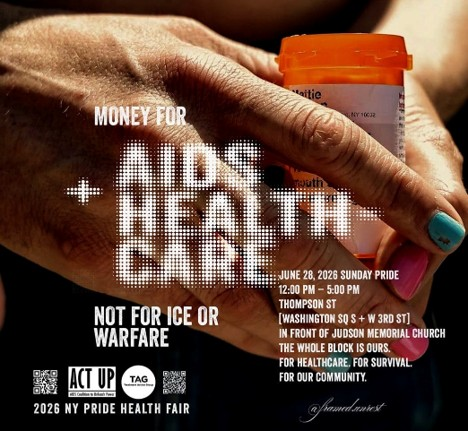
For those on the East Coast, join ACT UP NY on Sunday, June 28th from 12pm – 5pm at their annual pride health fair on Thompson Street, in front of the Judson Memorial Church. They will offer free STI testing, zines, t-shirts, Doxy PEP, Narcan, KN95 masks, xylazine and fentanyl drug test strips, water, legal advice, and indoor bathrooms to anyone who can join.
Interviewer’s Note:
Since this interview was conducted, NYC’s Department of Health and Mental Hygiene (DOHMH) has announced that they will introduce city-funded and city-run gender-affirming care services for adults at their free clinic location in Corona, Queens. Although ACT UP NY is not mentioned in this announcement, we are sure that this decision is directly related to the campaigns detailed above. The People’s CDC congratulates ACT UP NY. The fight will certainly continue to expand service locations and to include transgender youth.
Links to local resources listed in this interview
For free clinic services and locations in New York City, visit:
https://www.nyc.gov/site/doh/services/allclinics.page
To find free condoms and lubricant in New York City, visit:
https://a816-health.nyc.gov/NYCHealthMap/ServiceCategory/FreeSaferSexProducts