Public health continues to be under attack ranging from physical to political violence. We were disgusted and saddened by the shootings at the CDC headquarters in Atlanta, Georgia. The assailant had expressed anger at COVID vaccines and written about his desire to publicly demonstrate his discontent – holding the COVID vaccines in part responsible for his worsened mental health. In contrast to his sentiments, a cohort study conducted from 2020 to 2021 suggested that rates of worsened mental health after severe COVID infection were actually higher among unvaccinated individuals, rather than vaccinated individuals. The CDC Union has spoken out about the dangers of misinformation and so too must RFK Jr. condemn the violence and stop spreading false information that may have fueled the violence at the CDC.
We also disapprove of recent actions by Trump appointed leadership at the CDC who have selected an anti-vaxxer to lead the COVID-19 Vaccine Working Group. We are also furious that leaders in the Trump Administration are considering stopping access to lifesaving COVID vaccines. These vaccines – which ironically were the result originally of an effort by Donald Trump during his “Operation Warp Speed” – were researched and developed through immense time and effort by medical and biological scientists, along with many others across the world. COVID vaccines are estimated to have saved nearly 2.5 million people’s lives around the world from 2020 to 2024 as reported in a study published in JAMA Health Forum.
The Weather
The CDC-based wastewater map has not been updated since August 9, 2025. As a result, we are unable to provide an update on the map of wastewater levels at the state level for the past two weeks. Instead, we will report on wastewater levels from WastewasterSCAN and their regional wastewater trends. Up through August 18, 2025, WastewaterSCAN shows a continuous increase in SARS-CoV-2 in wastewater levels across all US regions including the Northeast, South, and Midwest, with a slight decrease in the West. These indicators demonstrate an ongoing summer surge in COVID infections, but at lower levels than during the summer of 2024.
Once the CDC resolves their wastewater data, we will return to reporting data from the CDC. We continue to encourage you to check your local region here to see more detailed local data. With this ongoing summer surge of COVID infections, we recommend as many layers of protection as all regions now have higher risk of COVID infections.
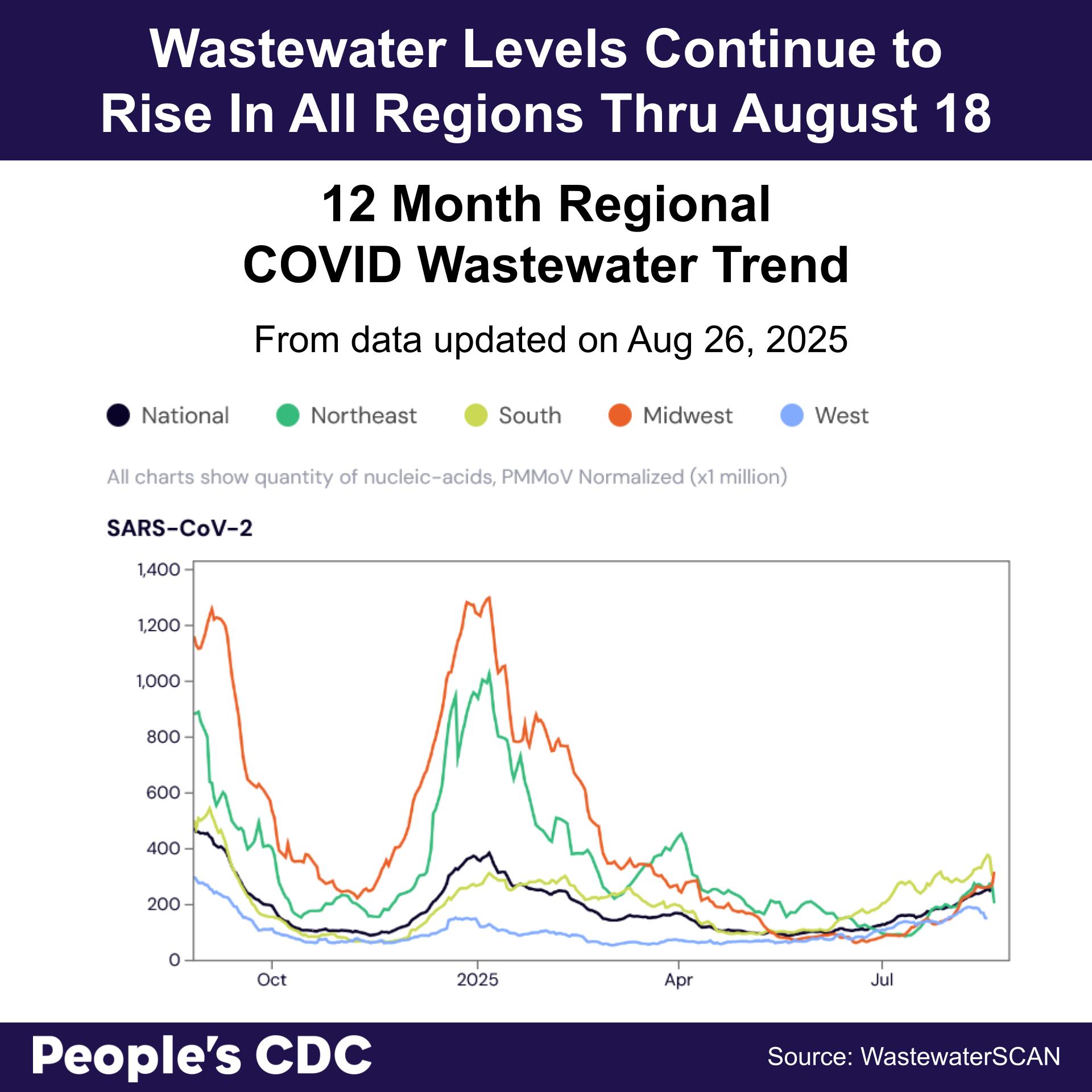
Graphic source: WastewaterSCAN
Emergency Room Use
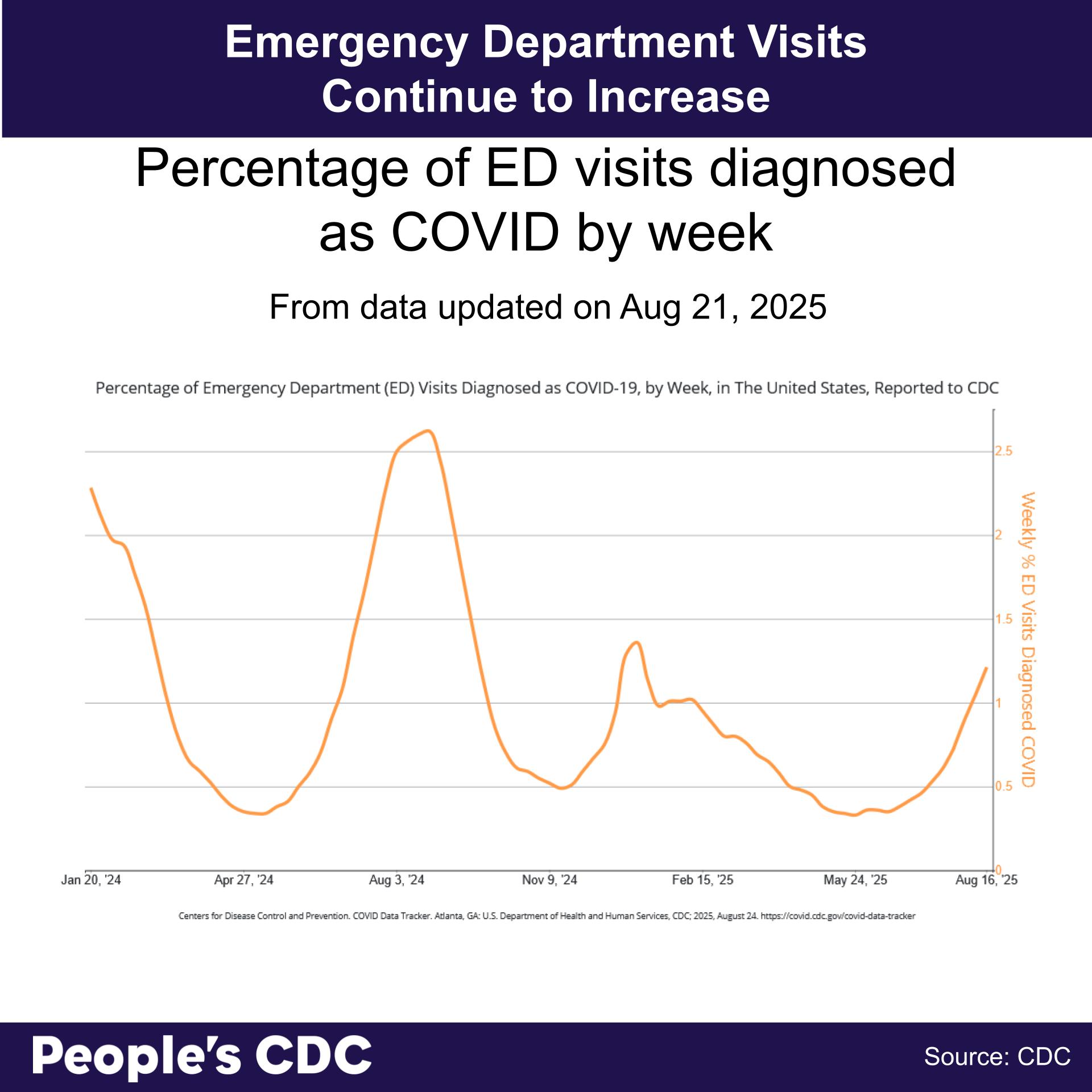
Another sign of the serious impact of COVID is the percent of emergency room visits involving a new COVID diagnosis. According to the CDC, the proportion of Emergency Room visits involving a COVID-19 diagnosis has risen significantly this summer, surpassing 1% of all visits as of August 21, 2025.
Variants
As of August 9, 2025, The CDC’s wastewater variant tracking shows that variant XFG makes up 65 percent of infections. This is now the dominant variant in the US and worldwide. Since the WHO’s initial assessment in June, this new variant, comprising variants LF.7 and LP.8.1.2, has resulted in increases in cases and hospitalizations and has been the cause of the summer surge of COVID infections. The WHO noted that current vaccines should offer protection from this new variant.
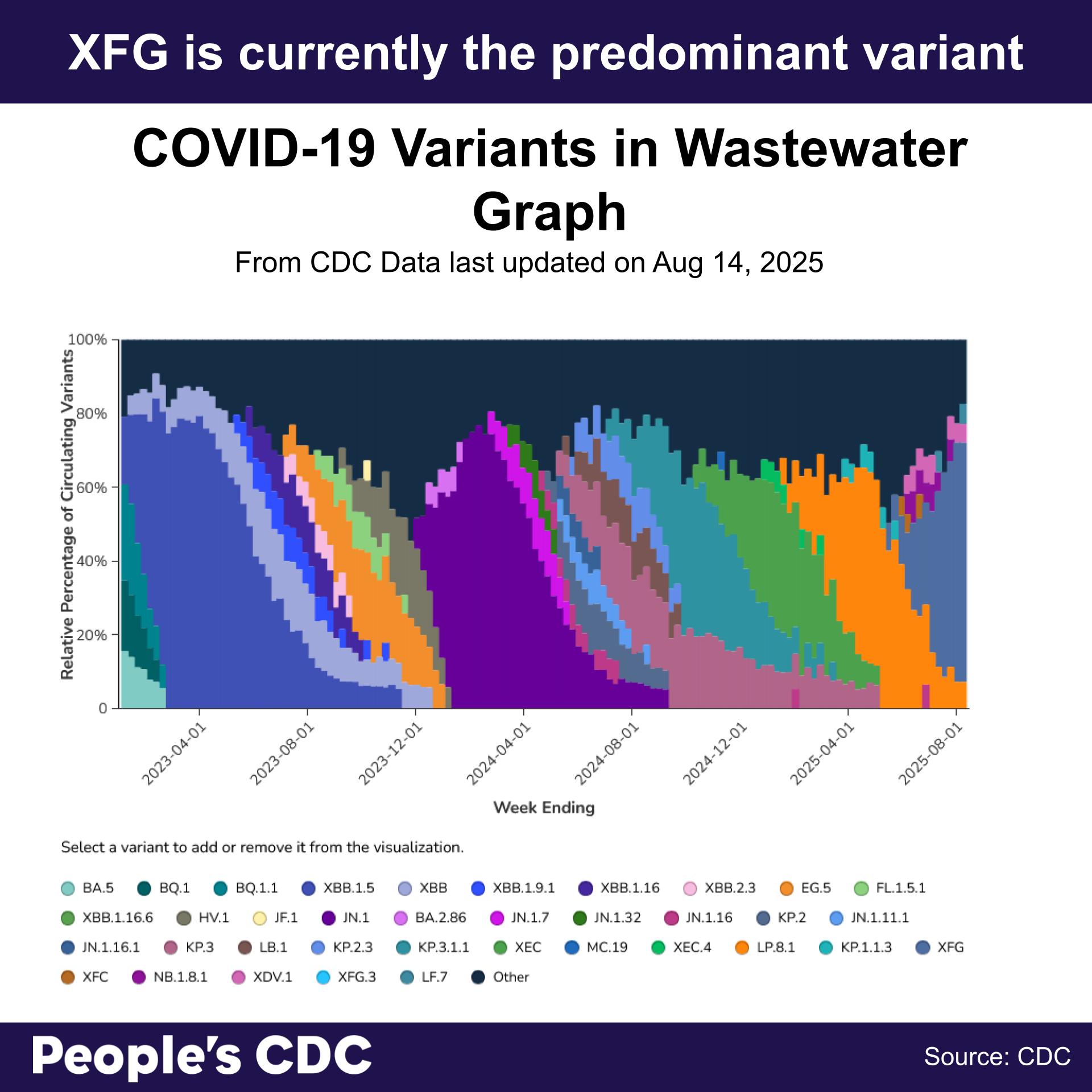
Graphic source: CDC Wastewater Variant Tracker
Long COVID
Ongoing efforts to understand and develop treatments for Long COVID continue to grow. Recently, a Long COVID research conference was held in New Mexico to continue this important work. Another similar hybrid conference focused on Long COVID is being held in Massachusetts in a few months. More studies are needed and you can learn about different opportunities to participate in clinical trials and studies at a list compiled by Long COVID Alliance.
A recent study published in Annals of Internal Medicine, reported a connection between social determinants of health and Long COVID outcomes. They found that people with social risk factors including financial hardship, food insecurity, less than a college education, experiences of medical discrimination, skipped medical care due to cost, lack of social support, and living in more crowded housing zip codes, were more likely to develop Long COVID at the time of a COVID infection. This highlights how Long COVID is not just a medical issue, but a social justice issue—one that reveals the connection between structural barriers to accessing support and unequal treatment of individuals by larger systems like healthcare, housing, and education, on health outcomes. Addressing Long COVID means addressing the structural barriers that put already marginalized communities at greater risk, and supporting efforts that work toward healthcare equity for all.
The exact number of people living with Long COVID is difficult to estimate, as it varies widely depending on how the condition is defined, particularly in terms of symptom duration and type as reported in JAMA Network Open. However, the effects of Long COVID continue to be devastating, with those navigating the condition utilizing healthcare services at an increased rate and sometimes with increased hospitalizations, as reported in a study in the journal of PLOS One. It was also found that Long COVID often leads to work impairment, missed work, and financial distress from a prospective cohort study in JAMA Network Open. But in a country like the US where access to healthcare is most often tied to our ability to work, this leaves those with Long COVID in an isolating and de-stabilizing position.
Take Action
COVID vaccines are under attack and they must remain universally accessible. RFK Jr. is attempting to end access to this important layer of protection from COVID infections. He must be held accountable for his intentional destruction of public health services. Write to Congress to save COVID vaccines and to remove RFK Jr. because of his destructive actions toward public health. You can submit a letter to your representatives in Congress, both the House and the Senate, via our Action Network or contact members Congress using their contact information, keeping our letter in full or editing it as you wish.
In order to protect vaccines, Senator Lisa Blunt Rochester has proposed bill S.2483 in Congress on July 28 to restore the CDC’s Advisory Committee on Immunization Practices (ACIP) in response to RFK’s removal of expert members. Along these lines, Senator Angus King proposed resolution S.Res.343 in Congress on July 29 to recognize the importance of another key healthcare committee, the US Preventive Services Task Force, which makes influential recommendations for preventative clinical services, which RFK is also attempting to end. Contact your elected members of Congress to express your support for both the bill and resolution to restore members of ACIP and preserve the US Preventive Services Task Force.
Healthcare settings must be safe from COVID infections. The deadline for comments to protect the reporting of COVID exposures and infections in healthcare settings has been extended from September 2, 2025 to November 1, 2025. Ensure Occupational Safety and Health Administration (OSHA) continues to require reporting of COVID exposures and infections in healthcare settings. We will provide a full set of instructions to address this policy closer to the deadline with a focus on ensuring healthcare acquired COVID infections are reported and prevented. Submit a written public comment to OSHA to maintain reporting of COVID exposures and infections in healthcare settings via the Federal Register no later than November 1, 2025 at 11:59 pm Eastern Daylight Time.
With the increased spread of COVID and measles in the US, we need to keep ourselves and our communities safe using KF94/KN95/N95 masking and as many layers of protection as possible. Our Safer Gathering Guide provides recommendations for safer meetings and gatherings. Please continue to share it!
Notes: 1) The numbers in this report were current as of 8/23/2025. 2) Check out the links throughout & see our website for more at https://peoplescdc.org. 3) Subscribe to our newsletter: People’s CDC | Substack.
If you’re donating to us through Substack, consider getting the Substack for free (it’s not paywalled!) and donating to us directly. That way, there are fewer fees for everyone.