People’s CDC COVID-19 Weather Report

The Weather

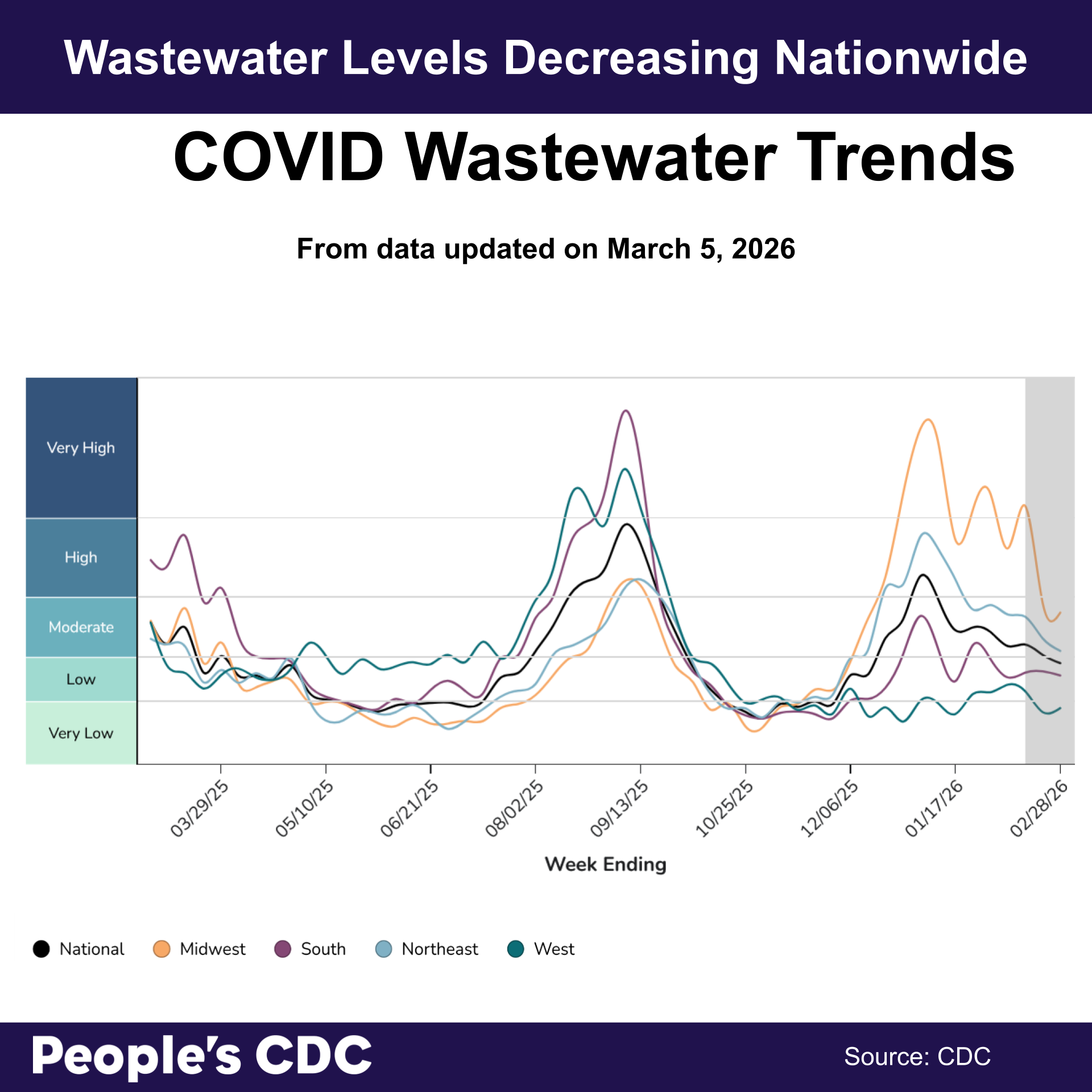
Wastewater levels for COVID have improved to “low” nationally. The CDC-based wastewater map was updated on March 5th, and it shows “high” levels in 7 states, “moderate” levels in 17 states, “low” levels in 15 states, and “very low” levels in 12 states and territories. Three states report limited coverage, meaning only some of the state’s wastewater centers are reporting, so the data are based on less than 5% of the population, and they may not be accurate for the entire state. North Dakota and the Virgin Islands still have no data. Regional data indicate that all regions are seeing SARS-CoV-2 detection in wastewater decreasing; the regions of the Midwest and Northeast have decreased to moderate levels, while the South and West are at low or very low levels.

Note: We will roll out a new map soon and look forward to your feedback!

As COVID levels continue to decrease, precautions remain important, including wearing N95/KN95/KF94 masks in public spaces, staying up to date with vaccinations, and using air cleaners (air “purifiers”) or opening windows whenever possible, especially as temperatures rise across the country.
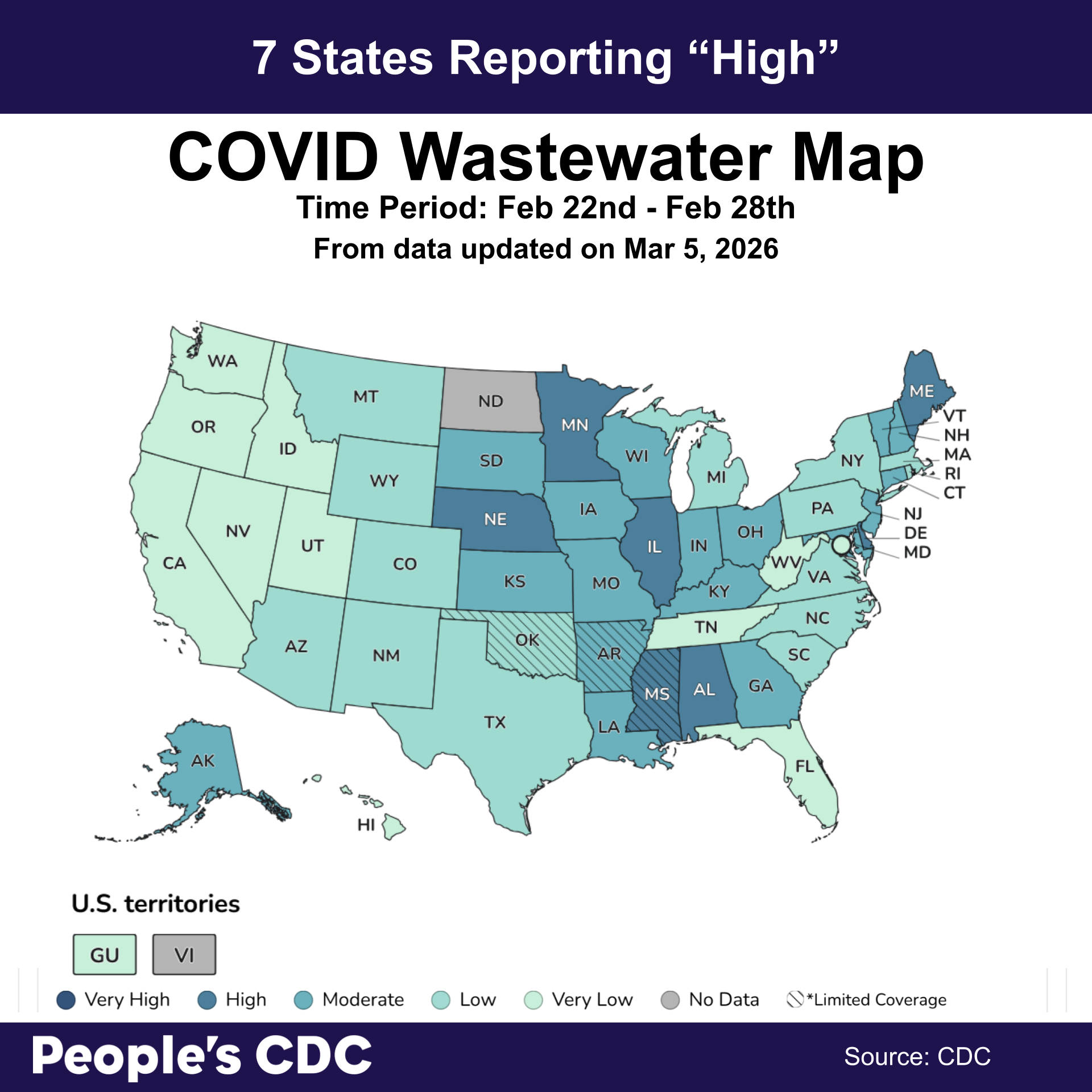
A map of the United States color-coded in shades of blue and teal displaying COVID Wastewater Viral Activity levels from CDC Data last updated on March 5, 2026 with a time period of Feb 22nd to Feb 28th. Deeper tones correlate to higher viral activity. Gray indicates “limited/no data” and stripes indicate “limited coverage” where data is based on less than 5% of the population and may not be accurate for the whole state. Darker shades of blue indicating “High” or “Moderate” levels are visible in the Midwest, as well as in Mississippi, Alabama, Maine and Delaware. No states are showing “very high” levels. Map header: 7 States reporting “high” levels. There is “limited/no data” data for North Dakota or the U.S. Virgin Islands, and limited coverage for Mississippi, Arkansas and Oklahoma. Text at the bottom reads “People’s CDC. Source: CDC.”Graphic source: CDC


A line graph’s title reads “wastewater levels decreasing nationwide.” The Y-axis is COVID concentration levels from “Very Low” to “Very High”. The X-axis dates are from March 29, 2025 through February 28, 2026. The line graph first peaks in 2025 in September. Levels go down nationally in October, but begin trending upward in late November 2025 reaching a second peak in early January 2026. The South, Northeast and national levels show decreases while the West and Midwest show slight increases. The Midwest and Northeast are in the “Moderate” range, national levels and the South are in “Low” and the West is in the “Very Low” range. After a prolonged time in the “Very High” and “High” ranges, this is the first time that Midwest levels have been in the “Moderate” range since early December 2025. Text at the bottom reads “People’s CDC. Source: CDC."

Graphic source: CDC

Measles

Measles continues to spread in the US, and since the start of 2026, the total cases have increased from 982 to 1,281. This surpasses 50% of all known cases in 2025.
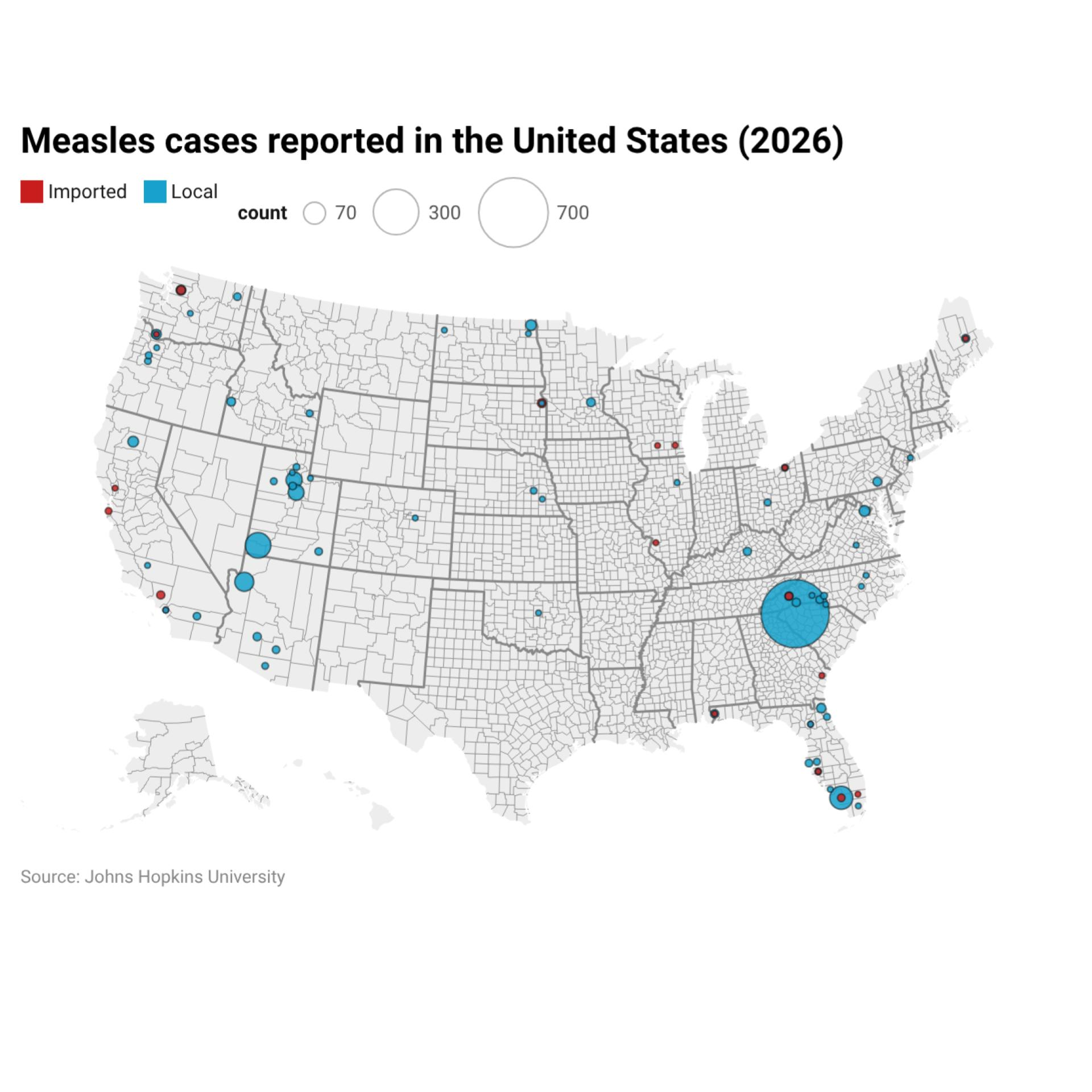
A light gray map of the US with county borders outlined in a darker gray depicts the “measles cases reported in the United States” so far in 2026. Colored circles of different sizes indicate the number of cases. A legend above the graphic shows that different sized circles represent 70 cases versus 300 cases versus 700 cases, where 700 cases is represented by the biggest sized circle and 70 cases is represented by the smallest. The circles are either red to depict “imported” measles cases or blue to depict “local” measles cases. The border between South Carolina, North Carolina, Tennessee and Georgia shares the largest blue or “local” outbreak circle of 674 cases since January 1st. Southwest Utah, southern Florida and northwest Arizona have the 2nd, 3rd and 4th largest blue or “local” outbreaks with circles that are sized to a case count of 80, 63 and 40 cases since January 1st respectively. Many other states have at least 1 blue or red circle representing case counts of approximately 10 or less, including California, Washington, Oregon, Idaho, Colorado, North Dakota, South Dakota, Nebraska, Oklahoma, Minnesota, Wisconsin, Illinois, Kentucky, Ohio, Virginia, New Jersey, Pennsylvania, and Maine. Text at the bottom reads “Johns Hopkins University”.

Source: International Vaccine Access Center

Precautions in Healthcare

Healthcare settings must continue to employ multiple layers of precautions to protect healthcare workers and patients. A recent cohort study in JAMA Network Open showed that precautions were effective in preventing viral spread among neonatal patients in healthcare settings during the early years of the pandemic. 

ACIP Update

The CDC’s Advisory Committee on Immunization Practices (ACIP) has delayed its meeting to March 18th and 19th. Two new members have also been appointed to ACIP. Their upcoming meeting agenda includes two topics: COVID vaccine injuries and Long COVID, both of which are serious matters, but we are concerned about their potential plan to spread incorrect information about these topics. We continue to strongly advocate for access to COVID vaccines. Submit a comment in support of COVID vaccines and resources to treat Long COVID by March 12th, 2026. You can also speak at the upcoming meeting by submitting your information to the CDC by March 12th, 2026. In the next few days, we will share a set of instructions for submitting a comment or adding your name to the pool of speakers.

Actions

Oppose Casey Means for Surgeon General, who remains uniquely unqualified for the job. Means recently completed her nomination hearing and continues to demonstrate her lack of necessary skills for this role. Previously, she questioned and doubted the importance of the childhood vaccine schedule. She also has a major financial conflict of interest through her company, which sells so-called “natural” products with the intent of opposing conventional medicine and profiting personally. Although she plans to resign from her company if confirmed as the next Surgeon General, her conspiratorial and unscientific beliefs around autism, raw milk, and birth control could cause grave harm to the public, especially as her platform and reach would expand exponentially if nominated. 

Remove RFK Jr. petition: A recent report from Protect Our Care named RFK Jr. “Public Health Enemy No 1.” We continue to call for the removal of RFK Jr., and Stand Up For Science has created its own petition to remove RFK Jr. as Secretary of Health and Human Services. We encourage you to read it and sign on.

Notes: 1) The numbers in this report were current as of 3/8/2026. 2) Check out the links throughout & see our website for more at https://peoplescdc.org. 3) Subscribe to our newsletter: People’s CDC | Substack.

If you’re donating to us through Substack, consider getting the Substack for free (it’s not paywalled!) and donating to us directly. That way, there are fewer fees for everyone.

Frequently Asked Questions (FAQs)

The People’s CDC is a coalition of public health practitioners, scientists, healthcare workers, educators, advocates and people from all walks of life working to reduce the harmful impacts of COVID-19.

We provide guidance and policy recommendations to governments and the public on COVID-19, disseminating evidence-based updates that are grounded in equity, public health principles, and the latest scientific literature.

Working alongside community organizations, we are building collective power and centering equity as we work together to end the pandemic. The People’s CDC is volunteer-run and independent of partisan political and corporate interests and includes anonymous local health department and other government employees. The People’s CDC is completely volunteer run with infrastructure support being provided by the People’s Science Network.

Though the People’s CDC was supported initially through a Robert Wood Johnson Foundation grant, that grant has long expired. We no longer pursue or accept grant funding. We are now entirely funded by people who donate to us. Most of these donations make their way to us through our Substack platform (which anyone can access for free!) or through purchases of People’s CDC swag. Our website now has a donate link for anonymous donations.

The content that we put out is entirely created by volunteers who receive no funding for their work. We pay one person for their labor–a digital organizer. They help us update and maintain our website, make sure we all know what meetings are happening and when, post our content on social media, and monitor our email. They also act as the point person between our organization and our fiscal sponsor, People’s Science Network.

We also pay for a People’s CDC T-shirt for any volunteer who wants one.

Share this: