Resistance to fascism growing at ICE detention facilities
Detainees at Delaney Hall have been on hunger and labor strike for nearly 2 weeks. The detainees report rotten food, and a lack of medical care and legal resources. Read the letter from inside Delaney Hall written by Leonardo, who has since been transferred out in an effort to break the strike, despite efforts of antifascist protestors outside to block his transfer. During these weeks, hundreds have shown up in support of the detainees.
To highlight what’s at stake, at least 51 people have lost their lives in ICE custody since Donald Trump’s second term. In many instances, these deaths have occurred in facilities that are run by for-profit companies which are given billions of taxpayer dollars. In the case of Delaney Hall, the facility was closed in 2017 and then reopened in February 2026 by GEO Group in return for 1 billion dollars of taxpayer money. To be clear, though it is particularly sickening that these abuses are making Trump’s friends even richer, we object to the horrors at these facilities regardless of detention ownership: for profit, non profit, and public, government owned and operated ICE facilities are equally problematic.
The strike at Delaney is one site of action. Strikes are also ongoing at Desert View Annex and Adelanto ICE Processing Center in Southern California; at Prairieland Detention center in Alvarado, Texas; by Rogelio Bolufe who was recently transferred to the Northwest Detention Center in Tacoma Washington. It is more important than ever that we get out and get active to support all detainees throughout the country. Read more here.
The Weather
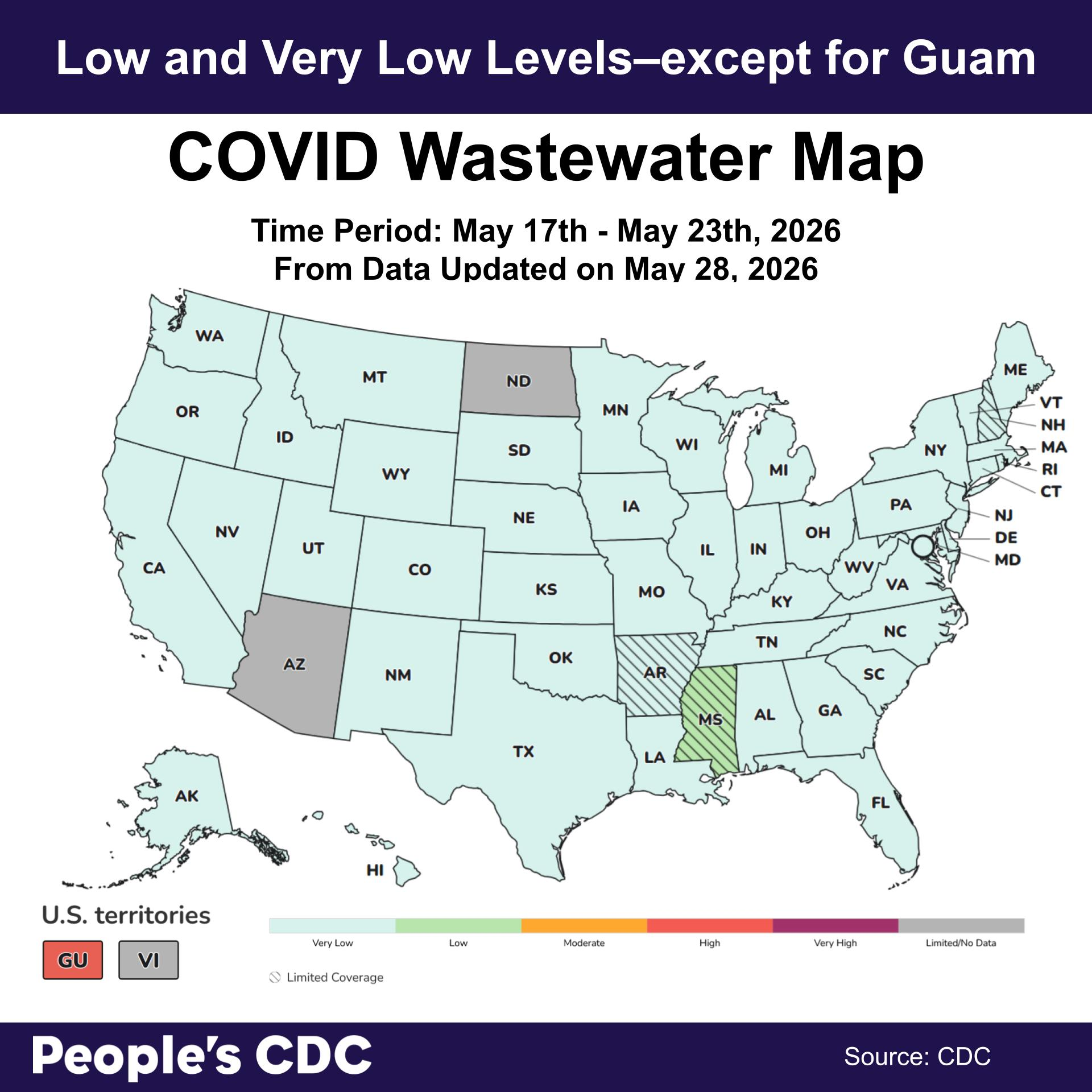
The CDC-based wastewater map was updated on May 28th and depicts wastewater levels for the period May 17th to May 23rd.
The vast majority of the US is experiencing “very low” levels, though Mississippi is at “low” levels. The CDC reports that Guam is experiencing “high” levels. Arizona, North Dakota, and the U.S. Virgin Islands are reporting “limited/no data.” New Hampshire, Mississippi, and Arkansas are reporting limited coverage, meaning that the data is based on less than 5% of the population and may not be accurate for the entire state.
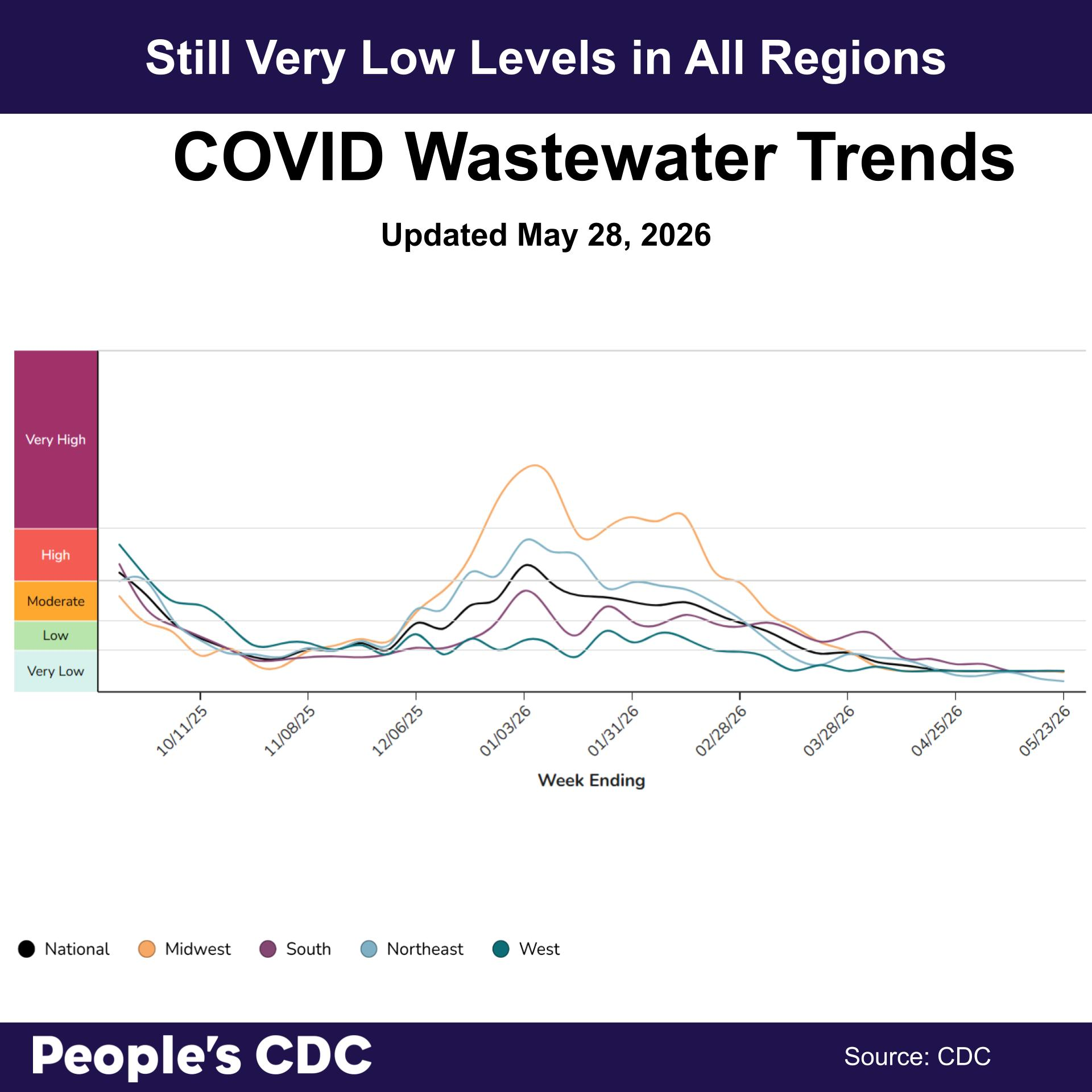
Regional trend data indicate that all regions remain at “very low” levels.
Other COVID News:
The FDA approved ensitrelvir as a novel drug to be used as post-exposure prophylaxis of COVID-19. A post-exposure prophylaxis is an emergency treatment used to prevent or mitigate infection after a potential exposure. The medication has previously been used in Japan. A recent study published in NEJM showed people in the ensitrelvir group experienced a 67% reduction in risk of getting COVID-19 compared to people in the placebo group.
The FDA’s Vaccine and Related Biological Products Advisory Committee (VRBPAC) voted to recommend a monovalent XFG vaccine for COVID-19 shots for the 2026-2027 season.
Other Infectious Diseases
Rotavirus
According to WastewaterSCAN, rotavirus is at “high” levels, with highest levels in the Northeast and Midwest. Rotavirus is an easily transmissible virus that can cause severe diarrhea and consequential dehydration in infants and children. The current rotavirus vaccine prevents 40,000 to 50,000 hospitalizations annually. Rotavirus is one of the vaccines that MAHA is making efforts to remove from the current vaccine schedule. Last week, Trump issued an executive order for HHS to move to adopt the limited schedule.
Ebola
The Ebola outbreak caused by the Bundibugyo virus continues to evolve in the Democratic Republic of the Congo and Uganda. According to the WHO, 906 cases and 223 deaths have been reported in the DRC. One healthcare provider from the US has been identified to have contracted the virus and is now undergoing treatment in Germany. We encourage readers to check out this Democracy Now coverage from last week to better understand how Ebola is a politically driven epidemic.
While the US tries (and fails) to coordinate its own quarantine center in Kenya, it has moved to ban non-citizens, including green-card holders from entering the US from affected countries.
Hantavirus
Last week, two more cases of hantavirus were detected among those being quarantined after disembarking from the affected cruise ship. The WHO is calling the situation stable.
Read this op ed from MS Now. We need to fund disease emergence research and prioritize international collaboration. We live in an interconnected (and warming) world. We can’t isolate ourselves healthy.
Actions
Oppose New Jail Development: Read this article: No New Beds and get involved in the fight to oppose new jail developments.
Remove RFK Jr. petition: A recent report from Protect Our Care named RFK Jr. “Public Health Enemy No 1.” We continue to call for the removal of RFK Jr., and Stand Up For Science has created its own petition to remove RFK Jr. as Secretary of Health and Human Services. We encourage you to read it and sign on.
Engage your representatives: Tell Your Senators: Vote “NO” on Saphier for U.S. Surgeon General. Nicole Saphier has been nominated to serve as U.S. Surgeon General. We must speak loudly and clearly: She is totally unqualified to serve in this important role and must be rejected by the Senate. She has spread lies about measles, hepatitis B, and COVID vaccination, sells quack cures on Amazon, and has no public health experience. It takes <2 minutes to write to your Senators. Write to them now!
Notes: 1) The numbers in this report were current as of 5/31/2026. 2) Check out the links throughout & see our website for more at https://peoplescdc.org. 3) Subscribe to our newsletter: People’s CDC | Substack.
If you’re donating to us through Substack, consider getting the Substack for free (it’s not paywalled!) and donating to us directly. That way, there are fewer fees for everyone.