The Weather
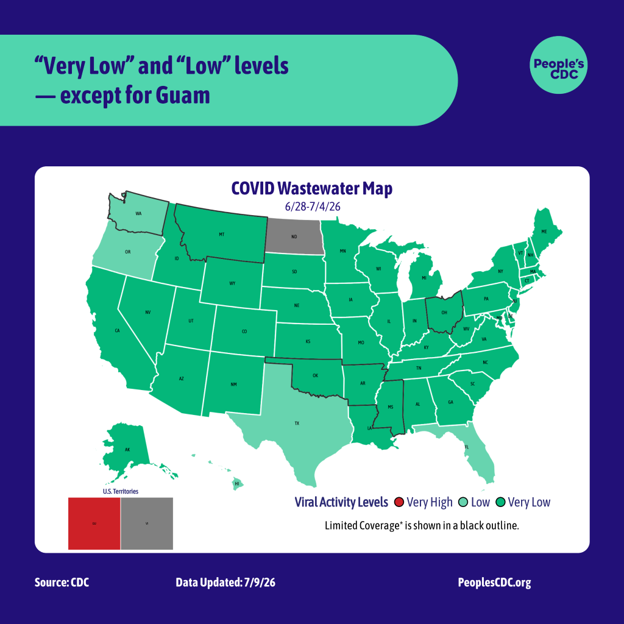
The CDC-based wastewater map was updated on July 9th and depicts wastewater levels for the period June 28th to July 4th.
The vast majority of the US continues to experience “Very Low” levels. Washington, Oregon and Hawaii have risen from “Very Low” to “Low” levels since our last report. Texas and Florida continue to report “Low” levels. Levels in Mississippi and Alaska have decreased from “Moderate” and “Low” respectively in our previous report to their current readings of “Very Low.”
Arkansas, Mississippi, Montana, Ohio, Oklahoma, and Washington are reporting “Limited Coverage,” meaning that the data is based on less than 5% of the population and may not be accurate for the entire state. North Dakota and the U.S. Virgin Islands are reporting “Limited/No Data.”
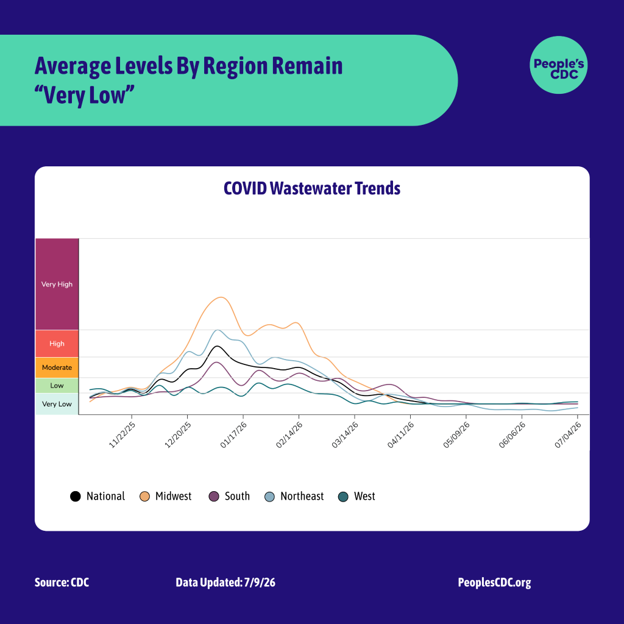
Regional trend data indicate that all regions remain at “Very Low” levels.
Cyclosporiasis
A parasite has been causing diarrheal illness across the US. Michigan, a state which usually sees about 50 cases/year has already seen 1000. Illinois, Ohio, New York, and North Carolina have all reported more than 100 cases. The parasite can be transmitted when food or water has been contaminated with feces, and past outbreaks have been linked to contaminated lettuce, berries, and other produce. The CDC has not yet been able to identify any particular cause of this outbreak.
Public Health During the World Cup
The 2026 World Cup is well under way, bringing millions of travelers to 11 US cities, Canada, and Mexico. With federal funding cuts and capacity limited, local health departments, academic institutions, and other nongovernmental organizations are stepping up to monitor and address travel- and gathering-related health issues. These include heat, drug, and alcohol related threats as well as infectious disease. For example, Health Security Operations Center is a collaboration run out of Georgetown’s Center for Global Health Science and Security intending to collect and synthesize data to provide guidance for local and state health agencies. You can find their daily reports here. The infectious disease monitoring strategies largely rely on wastewater – a strategy used in the 2022 World Cup in Doha to identify sites of COVID and enterovirus infections so health officials could intervene quickly.
While wastewater surveillance continues to prove useful at mitigating disease spread, CDC wastewater monitoring efforts are set to be scaled back. Current programming has been cut from $125 million annually to $25 million annually and the current contract with Verily Life Sciences expires in August.
Actions
Demand Continued Wastewater Surveillance!
Ask your congressional leaders to renew $125 million dollars of annual funding to the CDC National Wastewater Surveillance System to prevent it from going dark as soon as September 30th, 2026. This program remains one of the most valuable public health tools for detecting increased spread of infectious diseases such as COVID, measles, polio, Mpox, RSV, influenza and avian flu.
Notes: 1) The numbers in this report were current as of 07/13/2026. 2) Check out the links throughout & see our website for more at https://peoplescdc.org. 3) Subscribe to our newsletter: People’s CDC | Substack.
If you’re donating to us through Substack, consider getting the Substack for free (it’s not paywalled!) and donating to us directly. That way, there are fewer fees for everyone.