People’s CDC COVID-19 Weather Report

The Weather

The CDC-based wastewater map was updated on July 23rd and depicts wastewater levels for the period from July 12th to July 18th.

The majority of the US continues to experience “Very Low” levels. Alaska has risen from “Low,” and Guam has fallen from “Very High” since our last report to their current readings of “Moderate.” Washington, Florida, and Texas continue to report “Low” levels. Louisiana, Nevada, and New Mexico have risen from “Very Low” to “Low” levels since our last report. Oregon meanwhile, has fallen from “Low” to “Very Low” levels.

Arkansas, Missouri, Montana, Oklahoma, South Carolina, and Wyoming are reporting “Limited Coverage,” meaning that the data is based on less than 5% of the population and may not be accurate for the entire state. North Dakota and the U.S. Virgin Islands are reporting “Limited/No Data.” 
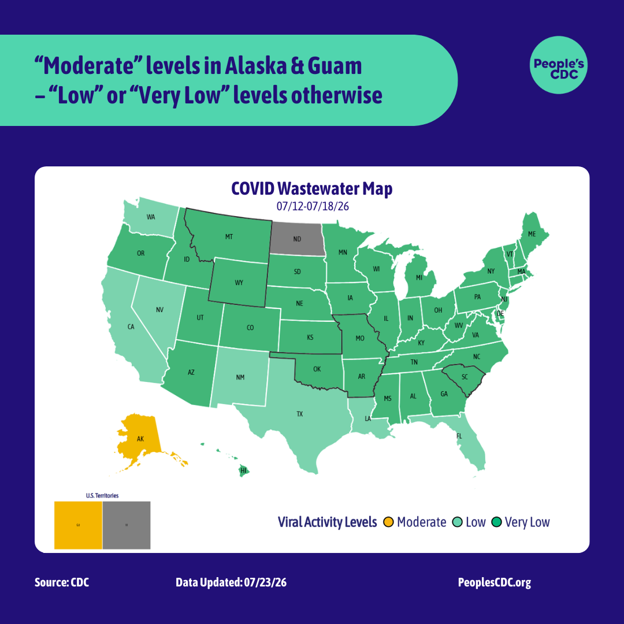
A COVID wastewater map of the United States based on the CDC’s data. Heading level one text: “Moderate” levels in Alaska & Guam – “Low” or “Very Low” levels otherwise.” Heading level two text: “COVID Wastewater Map.” Subheading text: “July  12th - July 18th 2026.”

The following color codes depict viral activity levels from lowest to highest: “very low” in dark green, “low” in light green and “moderate” in yellow. “limited/no data” is shown in gray.

On the map, the majority of the United States is in dark green meaning “very low” viral activity levels. Washington, California, Texas, Nevada, New Mexico, Louisiana and Florida are light green meaning “low” levels. Guam and Alaska both outliers are labeled yellow meaning “moderate” levels. U.S. Virgin Islands and North Dakota are gray meaning “limited/no data.” Montana, Missouri, Wyoming, Oklahoma, Arkansas, and South Carolina are outlined in black meaning “limited coverage.”

Footer: “Source: CDC, data updated July 23rd 2026, peoplescdc.org.”
Graphic source: CDC

Regional trend data indicate that all regions remain at “Very Low” levels.
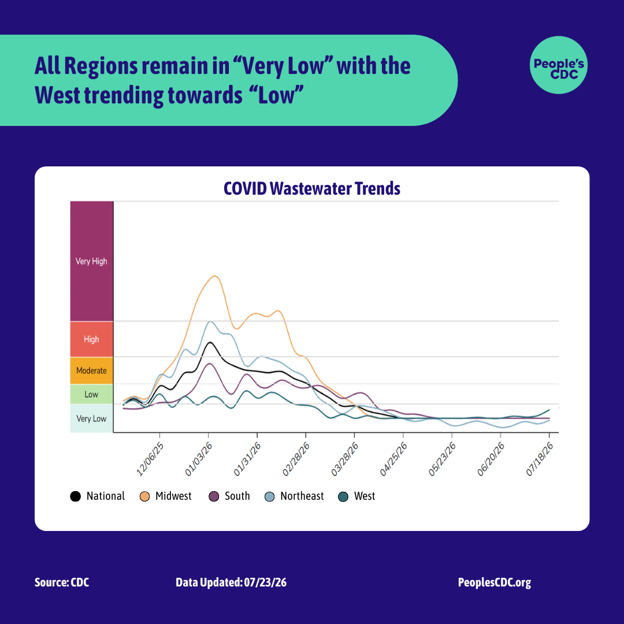
A line graph, based on CDC’s data. Heading level one text: “Average levels by region remain “very low” with the west trending towards “low.”” Heading level two text: “COVID Wastewater Trends.”

The y-axis is COVID concentration levels, from bottom to top, goes from “very low” to “very high.” The x-axis lists dates, from left to right, going from December 6th, 2025 through July 18th, 2026. The line graph peaks in December 2025 - February 2026. From February 2026, and onwards, the line graph goes down. Currently all regions have decreased to the “very low” level of concentration with the West noticeably uptrending towards “low”. 

Footer: “Source: CDC. Data updated July 23rd 2026, peoplescdc.org.”
Graphic source: CDC

Cyclosporiasis Update

The CDC has expanded the outbreak to nine states. The parasite causes diarrheal illness, and it can be transmitted when food or water has been contaminated with feces, and past outbreaks have been linked to contaminated lettuce, berries, and other produce. The CDC has linked one outbreak to lettuce from Taylor Farms sold at retail stores and served in restaurants, though it continues to investigate other outbreaks that are unrelated to the Taylor Farms outbreak. A list of products is included in the recall notice.

A War on the Left

Over the past two weeks, the Federal administration’s effort to eliminate progressive and equity-focused initiatives has directly reshaped federal public health policy. Notably, the Centers for Disease Control and Prevention (CDC) will end direct grant renewals to community-based organizations focused on HIV prevention among marginalized groups, shifting those funds to state health departments to bypass localized equity models. Simultaneously, as a July 24 deadline enforces mandatory anti-DEI clauses across federal contracting, healthcare providers, research institutions, and public health grant recipients face heightened risks of defunding if their programs use DEI frameworks, nonbinary gender categories, or targeted racial disparity metrics. Public health experts and policy analysts warn that these rapid shifts threaten to sever trusted grassroots outreach, dilute specialized care access, and worsen outcomes for historically underserved populations. 

While wastewater surveillance continues to prove useful at mitigating disease spread, CDC wastewater monitoring efforts are set to be scaled back. Current programming has been cut from $125 million annually to $25 million annually, and the current contract with Verily Life Sciences expires in August.

Actions

Demand Continued Wastewater Surveillance!

Ask your congressional leaders to renew $125 million dollars of annual funding to the CDC National Wastewater Surveillance System to prevent it from going dark as soon as September 30th, 2026. This program remains one of the most valuable public health tools for detecting increased spread of infectious diseases such as COVID, measles, polio, Mpox, RSV, influenza, and avian flu.

Notes: 1) The numbers in this report were current as of 07/23/2026. 2) Check out the links throughout & see our website for more at https://peoplescdc.org. 3) Subscribe to our newsletter: People’s CDC | Substack.

If you’re donating to us through Substack, consider getting the Substack for free (it’s not paywalled!) and donating to us directly. That way, there are fewer fees for everyone.

Frequently Asked Questions (FAQs)

The People’s CDC is a coalition of public health practitioners, scientists, healthcare workers, educators, advocates and people from all walks of life working to reduce the harmful impacts of COVID-19.

We provide guidance and policy recommendations to governments and the public on COVID-19, disseminating evidence-based updates that are grounded in equity, public health principles, and the latest scientific literature.

Working alongside community organizations, we are building collective power and centering equity as we work together to end the pandemic. The People’s CDC is volunteer-run and independent of partisan political and corporate interests and includes anonymous local health department and other government employees. The People’s CDC is completely volunteer run with infrastructure support being provided by the People’s Science Network.

Though the People’s CDC was supported initially through a Robert Wood Johnson Foundation grant, that grant has long expired. We no longer pursue or accept grant funding. We are now entirely funded by people who donate to us. Most of these donations make their way to us through our Substack platform (which anyone can access for free!) or through purchases of People’s CDC swag. Our website now has a donate link for anonymous donations.

The content that we put out is entirely created by volunteers who receive no funding for their work. We pay one person for their labor–a digital organizer. They help us update and maintain our website, make sure we all know what meetings are happening and when, post our content on social media, and monitor our email. They also act as the point person between our organization and our fiscal sponsor, People’s Science Network.

We also pay for a People’s CDC T-shirt for any volunteer who wants one.

Share this: