New Covid Vaccines Get FDA Approval for Fall 2026
The US Federal Drug Administration (FDA) has approved four new COVID vaccine formulations for the fall from Moderna, Pfizer, and Novavax, all targeting the XFG variant which, along with its descendants, is likely the most dominant strain, though more recent sequencing data is limited. These vaccines should be available in your local pharmacies soon if they are not already.
The Moderna and Pfizer vaccines are mRNA-based and Novavax is protein-based. Moderna developed two new COVID vaccines: Spikevax and mNexspike. Pfizer’s new vaccine is called Comirnaty, and Novavax’ new vaccine is called Nuvaxovid. All four vaccines are approved for everyone 65 years and older. For those under 65, only those with an underlying condition that puts them at high risk for severe COVID are approved. Please see the below table for specifics on age approvals for each vaccine. Updated COVID vaccines have been repeatedly demonstrated to safeguard against severe illness and hospitalization in people of all ages, because COVID mutates and requires updated, targeted protection. The CDC’s official list of high-risk conditions is extensive and likely includes most Americans, so many under 65 are eligible for these shots and may not know it. Conditions that increase your risk include diabetes mellitus, type 1 and 2, depression, anxiety, ADHD and other mood disorders, smokers, those who are physically obese, overweight and physically inactive and others which encompass significant portions of the American population. When booking an appointment for one of these vaccines at a pharmacy, medical documentation should not be necessary. Pharmacists may not be aware that “high risk” includes many conditions beyond being immunocompromised, so you should prepare for that potential discussion. As always, this is not official legal or medical advice.
Last year, the American Association of Pediatric recommended vaccination for children, particularly those who have an existing health condition or live with someone who does. The Northeast Public Health Collaborative, a coalition of State Governors in the Northeastern US, recommended all adults 19-64 be vaccinated. We anticipate these recommendations will be repeated this year by other non-federal associations, thus updated COVID vaccines may eventually be available to all across the country.
COVID Vaccines Approved for Fall 2026
Brand | Vaccine Name | Full Approval Ages | Approval with underlying conditions | Targeted Variant | Vaccine type |
Moderna | Spikevax | 65+ years | 6 months – 64 years | XFG | mRNA |
Moderna | mNexspike | 65+ years | 12 – 64 years | XFG | mRNA |
Pfizer | Comirnaty | 65+ years | 5 – 64 years | XFG | mRNA |
Novavax | Nuvaxovid | 65+ years | 12 – 64 years | XFG | Protein |
Two Measles Patients Die in Pennsylvania
Recently in Pennsylvania, two infants who tested positive for measles have died, marking the first measles deaths in the country in 2026 and the first in Pennsylvania in 35 years. This comes as the measles outbreaks across the US continue to rage and RFK Jr. continues to downplay them. As such, RFK Jr. instructed the new CDC Director to remove these deaths from the CDC’s official tally. The Secretary, who has no medical or public health training, claimed the children had underlying conditions so they might have died with measles and not from measles. A tactic the federal government has grown quite comfortable using to minimize COVID deaths. Additional investigations into these deaths began and a Pennsylvania coroner has officially determined one of these deaths is from measles. Neither of the infants who died were old enough to be vaccinated, reaffirming the necessity of every eligible person to be fully vaccinated so we can attain herd immunity and protect the vulnerable in our communities. Reported measles cases in the US this year have already surpassed the entirety of 2025 by almost 900, and we still have 4 months of the year left.
The Weather
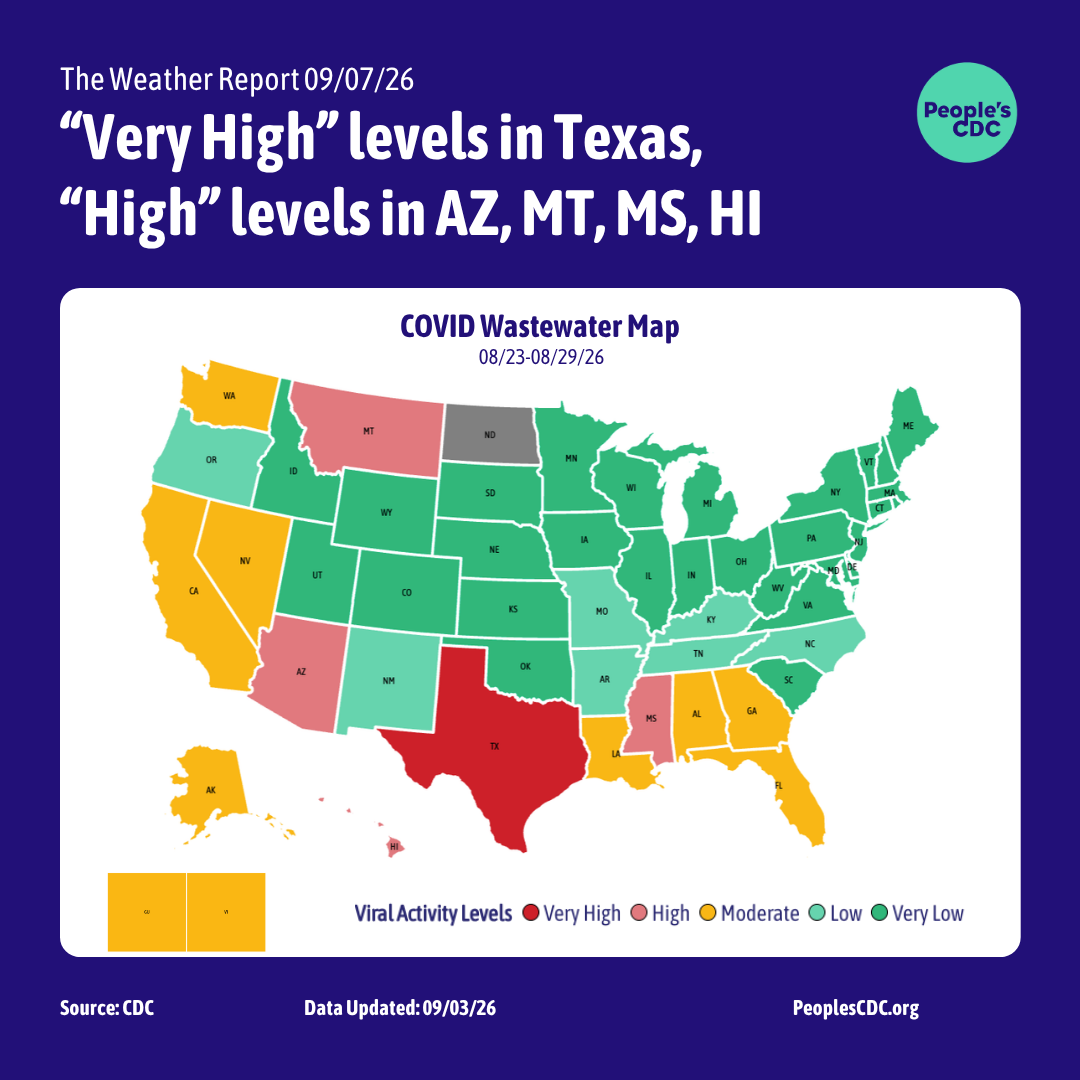
The CDC-based wastewater map was updated on September 3 and depicts wastewater levels for the period from August 23 through August 29. We can see increases in COVID levels across the country.
According to the CDC’s COVID Wastewater Viral Activity map, Texas is experiencing “Very High” levels, Montana, Arizona, Mississippi, and Hawaii are experiencing “High Levels” though the data from Montana and Mississippi are limited. Ten states and territories are experiencing “Moderate” levels. Seven states and Washington DC are experiencing “Low” levels and the remaining 30 states are experiencing “Very Low” levels.
Montana, Oklahoma, Arkansas, Mississippi, South Carolina, and New York are all reporting “Limited Coverage,” meaning that the data is based on less than 5% of the population and may not be accurate for the entire state. North Dakota is reporting “Limited/No Data.”
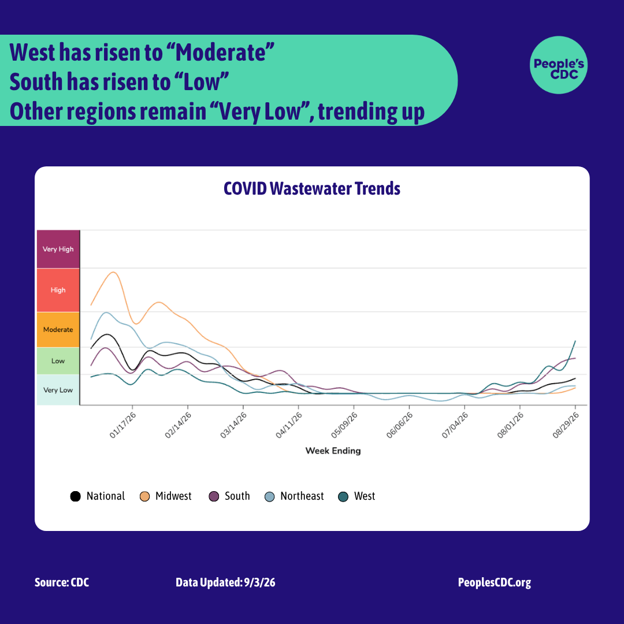
Regional trend data indicate the West has risen from “Low” to “Moderate.” The South has risen to “Low” with other regions remaining in “Very Low” but trending up.
A school district in San Antonio, Texas closed all campuses for two days just as the new school year began in an attempt to control the uncontrolled spread of COVID in the community. While a two day closure doesn’t cover the entire period most people are infectious and may not halt the community spread entirely, we commend the school district for making the brave decision to enact common-sense public health measures in a state with leaders so determined to ignore public health.
CDC Epidemic Trends
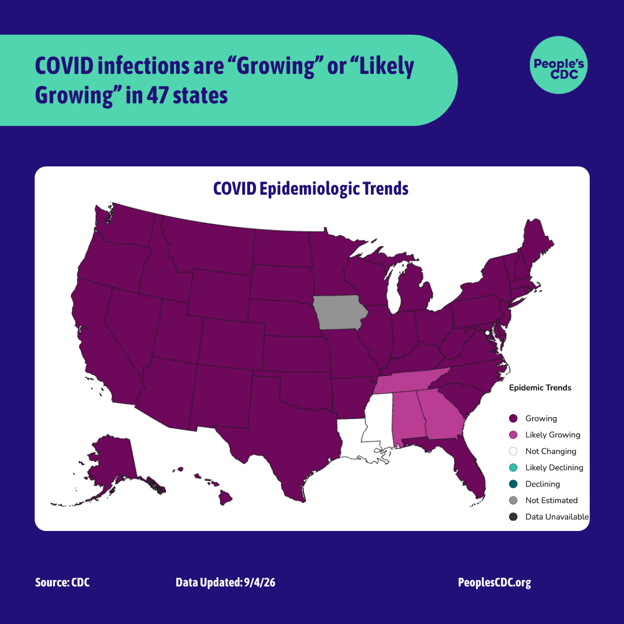
According to CDC Epidemic Trend data, there is a probability that the number of infections is “Growing” or “Likely Growing” at the state level nationwide, with the exception of Louisiana and Mississippi where it is “Not Changing.” Iowa is “Not Estimated.” We are in a wave and as schools continue to start up for the fall term, spread is likely to continue to grow. Please check out our Safer Gatherings Guide that can be used for class, work, back-to-school nights, and any other gathering you may attend.
These values are estimations based on a formula rather than measured data. It is estimated from daily incident emergency department visits reported through the National Syndromic Surveillance Program. It can tell us whether a current epidemic trend is growing, declining, or not changing, and is an additional tool to help public health practitioners prepare and respond. It cannot tell us about the underlying burden of disease, just the trend in infections. An Rt < 1 does not mean that transmission is low, just that infections are declining. They could be declining from a high level to another slightly lower high level.
Wastewater Surveillance at Risk
While wastewater surveillance continues to prove useful at mitigating disease spread, CDC wastewater monitoring efforts are set to be scaled back. Current programming has been cut from $125 million annually to $25 million annually, and the contract with Verily Life Sciences has been briefly extended to a new expiration date of September 14. The pressure that we are putting on Congress to continue these contracts is working. Now more than ever, it is important to ramp up both emails and calls. See more on how to do this in our “Take Action!” section.
Remembering Public Health Philanthropist Dolly Parton
On August 25th, the world lost country music legend and public health philanthropist Dolly Parton. We want to commemorate her and acknowledge the work she did to make this world a better place. In April of 2020, as the pandemic raged and political lines were already being drawn regarding the seriousness of the virus, Dolly Parton donated one million dollars to fund mRNA COVID vaccine development at Vanderbilt University in her home state of Tennessee. She may not have been a scientist herself, but she understood and valued the necessity of tackling this historic moment head-on. In 2022, she donated another $1 million to Vanderbilt for pediatric infectious disease research. For 31 years, she led the Dolly Parton Imagination Library, which encouraged literacy by providing free books to children from birth to 5 years old. This may not seem like it, but it is absolutely a public health program as low literacy is associated with worse health outcomes. We lost a giant and hope Dolly’s legacy will inspire generations to come to aid their communities like she did.
Take Action!
Reject Medicaid Work Requirements and One Big Beautiful Bill
If you live in Arizona, California, Colorado, Connecticut, Delaware, the District of Columbia, Hawaii, Illinois, Maine, Maryland, Massachusetts, Michigan, Minnesota, Nevada, New Jersey, New Mexico, New York, Washington, Wisconsin, Kentucky or Pennsylvania, call and email your attorney general to voice your approval over their participation in Case No. 26-12962, the lawsuit against the implementation of Medicaid work requirements. If you reside outside of these states, call and email your attorney general to encourage them to join the lawsuit. Additionally, residents of all states should call and email their governors asking them to be liberal in their interpretation and enforcement of Medicaid work requirements and in their process of determining who is exempt and who qualifies as “medically fragile.” Tell your governor and your attorney general to support Medicaid for All which would save both 114,000 lives per year and $1 trillion, and to reject work requirements for healthcare and One Big Beautiful Bill wholesale.
Demand Continued Wastewater Surveillance!
Ask your congressional leaders to renew $125 million dollars of annual funding to the CDC National Wastewater Surveillance System to prevent it from going dark as soon as September 30, 2026. In addition to the above Action Network campaign, consider giving both your representatives and congresspeople a phone call to record your dissent. This program remains one of the most valuable public health tools for detecting increased spread of infectious diseases such as COVID, measles, polio, mpox, RSV, influenza, and avian flu.
Notes: 1) The numbers in this report were current as of 9/42026. 2) Check out the links throughout & see our website for more at https://peoplescdc.org. 3) Subscribe to our newsletter: People’s CDC | Substack.
If you’re donating to us through Substack, consider getting the Substack for free (it’s not paywalled!) and donating to us directly. That way, there are fewer fees for everyone.